


Page 167 - Sedimentology and Stratigraphy
P. 167
154    Lakes


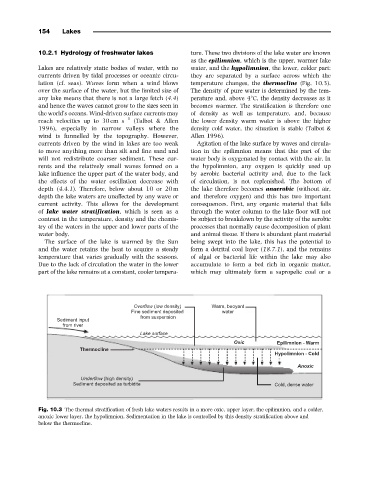
                  10.2.1 Hydrology of freshwater lakes        ture. These two divisions of the lake water are known
                                                              as the epilimnion, which is the upper, warmer lake
                  Lakes are relatively static bodies of water, with no  water, and the hypolimnion, the lower, colder part:
                  currents driven by tidal processes or oceanic circu-  they are separated by a surface across which the
                  lation (cf. seas). Waves form when a wind blows  temperature changes, the thermocline (Fig. 10.3).
                  over the surface of the water, but the limited size of  The density of pure water is determined by the tem-
                  any lake means that there is not a large fetch (4.4)  perature and, above 48C, the density decreases as it
                  and hence the waves cannot grow to the sizes seen in  becomes warmer. The stratification is therefore one
                  the world’s oceans. Wind-driven surface currents may  of density as well as temperature, and, because
                  reach velocities up to 30 cm s  1  (Talbot & Allen  the lower density warm water is above the higher
                  1996), especially in narrow valleys where the  density cold water, the situation is stable (Talbot &
                  wind is funnelled by the topography. However,  Allen 1996).
                  currents driven by the wind in lakes are too weak  Agitation of the lake surface by waves and circula-
                  to move anything more than silt and fine sand and  tion in the epilimnion means that this part of the
                  will not redistribute coarser sediment. These cur-  water body is oxygenated by contact with the air. In
                  rents and the relatively small waves formed on a  the hypolimnion, any oxygen is quickly used up
                  lake influence the upper part of the water body, and  by aerobic bacterial activity and, due to the lack
                  the effects of the water oscillation decrease with  of circulation, is not replenished. The bottom of
                  depth (4.4.1). Therefore, below about 10 or 20 m  the lake therefore becomes anaerobic (without air,
                  depth the lake waters are unaffected by any wave or  and therefore oxygen) and this has two important
                  current activity. This allows for the development  consequences. First, any organic material that falls
                  of lake water stratification, which is seen as a  through the water column to the lake floor will not
                  contrast in the temperature, density and the chemis-  be subject to breakdown by the activity of the aerobic
                  try of the waters in the upper and lower parts of the  processes that normally cause decomposition of plant
                  water body.                                 and animal tissue. If there is abundant plant material
                    The surface of the lake is warmed by the Sun  being swept into the lake, this has the potential to
                  and the water retains the heat to acquire a steady  form a detrital coal layer (18.7.1), and the remains
                  temperature that varies gradually with the seasons.  of algal or bacterial life within the lake may also
                  Due to the lack of circulation the water in the lower  accumulate to form a bed rich in organic matter,
                  part of the lake remains at a constant, cooler tempera-  which may ultimately form a sapropelic coal or a


                  Fig. 10.3 The thermal stratification of fresh lake waters results in a more oxic, upper layer, the epilimnion, and a colder,
                  anoxic lower layer, the hypolimnion. Sedimentation in the lake is controlled by this density stratification above and
                  below the thermocline.

