


Page 169 - Sedimentology and Stratigraphy
P. 169
156    Lakes


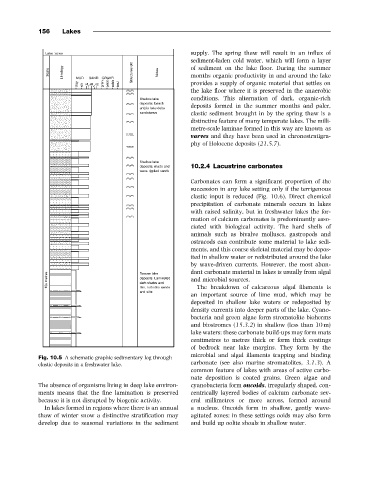
                                                              supply. The spring thaw will result in an influx of
                                                              sediment-laden cold water, which will form a layer
                                                              of sediment on the lake floor. During the summer
                                                              months organic productivity in and around the lake
                                                              provides a supply of organic material that settles on
                                                              the lake floor where it is preserved in the anaerobic
                                                              conditions. This alternation of dark, organic-rich
                                                              deposits formed in the summer months and paler,
                                                              clastic sediment brought in by the spring thaw is a
                                                              distinctive feature of many temperate lakes. The milli-
                                                              metre-scale laminae formed in this way are known as
                                                              varves and they have been used in chronostratigra-
                                                              phy of Holocene deposits (21.5.7).


                                                              10.2.4 Lacustrine carbonates

                                                              Carbonates can form a significant proportion of the
                                                              succession in any lake setting only if the terrigenous
                                                              clastic input is reduced (Fig. 10.6). Direct chemical
                                                              precipitation of carbonate minerals occurs in lakes
                                                              with raised salinity, but in freshwater lakes the for-
                                                              mation of calcium carbonates is predominantly asso-
                                                              ciated with biological activity. The hard shells of
                                                              animals such as bivalve molluscs, gastropods and
                                                              ostracods can contribute some material to lake sedi-
                                                              ments, and this coarse skeletal material may be depos-
                                                              ited in shallow water or redistributed around the lake
                                                              by wave-driven currents. However, the most abun-
                                                              dant carbonate material in lakes is usually from algal
                                                              and microbial sources.
                                                                The breakdown of calcareous algal filaments is
                                                              an important source of lime mud, which may be
                                                              deposited in shallow lake waters or redeposited by
                                                              density currents into deeper parts of the lake. Cyano-
                                                              bacteria and green algae form stromatolite bioherms
                                                              and biostromes (15.3.2) in shallow (less than 10 m)
                                                              lake waters: these carbonate build-ups may form mats
                                                              centimetres to metres thick or form thick coatings
                                                              of bedrock near lake margins. They form by the
                                                              microbial and algal filaments trapping and binding
                  Fig. 10.5 A schematic graphic sedimentary log through
                  clastic deposits in a freshwater lake.      carbonate (see also marine stromatolites, 3.1.3). A
                                                              common feature of lakes with areas of active carbo-
                                                              nate deposition is coated grains. Green algae and
                  The absence of organisms living in deep lake environ-  cyanobacteria form oncoids, irregularly shaped, con-
                  ments means that the fine lamination is preserved  centrically layered bodies of calcium carbonate sev-
                  because it is not disrupted by biogenic activity.  eral millimetres or more across, formed around
                    In lakes formed in regions where there is an annual  a nucleus. Oncoids form in shallow, gently wave-
                  thaw of winter snow a distinctive stratification may  agitated zones: in these settings ooids may also form
                  develop due to seasonal variations in the sediment  and build up oolite shoals in shallow water.

