


Page 182 - Sedimentology and Stratigraphy
P. 182
Wave and Storm Processes    169


                                                              same way. At the highest tides the current is strongest
                                                              enabling more transport and deposition of sand on the
                                                              bedforms in the flow. When the difference between
                                                              high and low tide is smaller the current will transport
                                                              a reduced bedload or there may be no sediment move-
                                                              ment at all. A cyclical variation in the thickness of
                                                              foreset laminae in cross-beds may therefore be attrib-
                                                              uted to variations in flow strength in the neap–spring
                                                              cycle and these are called tidal bundles. In an ide-
                                                              alised case, the laminae would show thickness vari-
                                                              ations in cycle in multiples of 7 or 14 (Yang & Nio
                                                              1985), but there is often no sedimentation or bedform
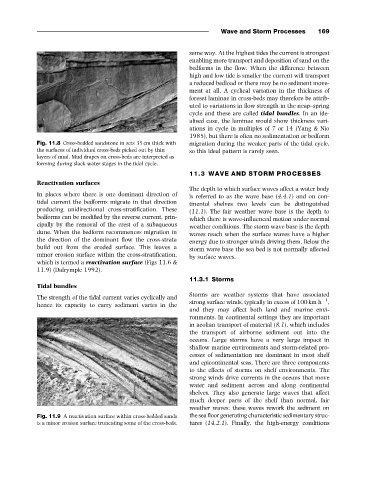
                 Fig. 11.8 Cross-bedded sandstone in sets 35 cm thick with  migration during the weaker parts of the tidal cycle,
                 the surfaces of individual cross-beds picked out by thin  so this ideal pattern is rarely seen.
                 layers of mud. Mud drapes on cross-beds are interpreted as
                 forming during slack water stages in the tidal cycle.
                                                              11.3 WAVE AND STORM PROCESSES
                 Reactivation surfaces
                                                              The depth to which surface waves affect a water body
                 In places where there is one dominant direction of  is referred to as the wave base (4.4.1) and on con-
                 tidal current the bedforms migrate in that direction  tinental shelves two levels can be distinguished
                 producing unidirectional cross-stratification. These  (11.1). The fair weather wave base is the depth to
                 bedforms can be modified by the reverse current, prin-  which there is wave-influenced motion under normal
                 cipally by the removal of the crest of a subaqueous  weather conditions. The storm wave base is the depth
                 dune. When the bedform recommences migration in  waves reach when the surface waves have a higher
                 the direction of the dominant flow the cross-strata  energy due to stronger winds driving them. Below the
                 build out from the eroded surface. This leaves a  storm wave base the sea bed is not normally affected
                 minor erosion surface within the cross-stratification,  by surface waves.
                 which is termed a reactivation surface (Figs 11.6 &
                 11.9) (Dalrymple 1992).
                                                              11.3.1 Storms
                 Tidal bundles
                                                              Storms are weather systems that have associated
                 The strength of the tidal current varies cyclically and
                                                                                                     1
                                                              strong surface winds, typically in excess of 100 km h ,
                 hence its capacity to carry sediment varies in the
                                                              and they may affect both land and marine envi-
                                                              ronments. In continental settings they are important
                                                              in aeolian transport of material (8.1), which includes
                                                              the transport of airborne sediment out into the
                                                              oceans. Large storms have a very large impact in
                                                              shallow marine environments and storm-related pro-
                                                              cesses of sedimentation are dominant in most shelf
                                                              and epicontinental seas. There are three components
                                                              to the effects of storms on shelf environments. The
                                                              strong winds drive currents in the oceans that move
                                                              water and sediment across and along continental
                                                              shelves. They also generate large waves that affect
                                                              much deeper parts of the shelf than normal, fair
                                                              weather waves: these waves rework the sediment on
                 Fig. 11.9 A reactivation surface within cross-bedded sands  the sea floor generating characteristic sedimentary struc-
                 is a minor erosion surface truncating some of the cross-beds.  tures (14.2.1). Finally, the high-energy conditions

