


Page 129 - Separation process engineering
P. 129
low for most industrial applications.
                    At even higher vapor flow rates the froth regime occurs. In this regime the liquid is continuous and has

                    large, pulsating voids of vapor rapidly passing through it. The surface of the liquid is boiling violently,
                    and there is considerable splashing. The liquid phase is thoroughly mixed, but the vapor phase is not. In
                    most distillation systems where the liquid-phase mass transfer controls, this regime has good efficiency.
                    Because of the good efficiency and reasonable vapor capacity, this is usually the flow regime used in
                    commercial operation.

                    At even higher gas flow rates the vapor-liquid contact on the stage changes markedly. In the spray regime
                    the vapor is continuous and the liquid occurs as a discontinuous spray of droplets. The vapor is very well
                    mixed, but the liquid droplets usually are not. Because of this poor liquid mixing, the mass transfer rate is
                    usually low and stage efficiencies are low. The significance of this is that relatively small increases in
                    vapor velocity can cause the column to go from the froth to the spray regime and cause a significant
                    decrease in stage efficiency (for example, from 65% to 40%).
                    A variety of other configurations and modifications of the basic design shown in Figures 3-6 and 3-7 are
                    possible. Valve trays (see Chapter 10) are popular. Downcomers can be chords of a circle as shown or

                    circular pipes. Both partial and total condensers and a variety of reboilers are used. The column may
                    have multiple feeds, sidestream withdrawals, intermediate reboilers or condensers, and so forth. The
                    column also usually has a host of temperature, pressure, flow rate, and level measurement and control
                    devices. Despite this variety, the operating principles are the same as for the simple distillation column
                    shown in Figure 3-6.

                    3.3 Specifications

                    In the design or operation of a distillation column, a number of variables must be specified. For both
                    design and simulation problems we usually specify column pressure (which sets the equilibrium data);

                    feed composition, flow rate and feed temperature or feed enthalpy or feed quality; and temperature or
                    enthalpy of the reflux liquid. The usual reflux condition set is a saturated liquid reflux. These variables
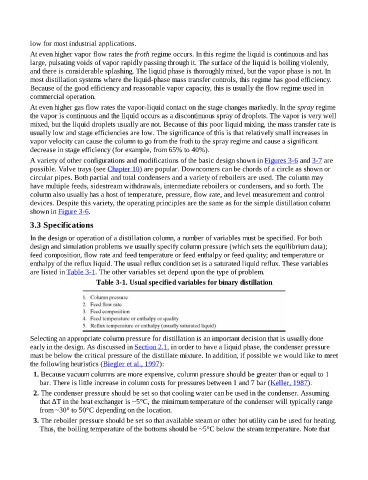
                    are listed in Table 3-1. The other variables set depend upon the type of problem.
                                              Table 3-1. Usual specified variables for binary distillation


                    Selecting an appropriate column pressure for distillation is an important decision that is usually done
                    early in the design. As discussed in Section 2.1, in order to have a liquid phase, the condenser pressure
                    must be below the critical pressure of the distillate mixture. In addition, if possible we would like to meet
                    the following heuristics (Biegler et al., 1997):
                     1. Because vacuum columns are more expensive, column pressure should be greater than or equal to 1

                        bar. There is little increase in column costs for pressures between 1 and 7 bar (Keller, 1987).
                     2. The condenser pressure should be set so that cooling water can be used in the condenser. Assuming
                        that ΔT in the heat exchanger is ~5°C, the minimum temperature of the condenser will typically range
                        from ~30° to 50°C depending on the location.

                     3. The reboiler pressure should be set so that available steam or other hot utility can be used for heating.
                        Thus, the boiling temperature of the bottoms should be ~5°C below the steam temperature. Note that

