


Page 117 - Silence in Intercultural Communication
P. 117
104  Silence in Intercultural Communication


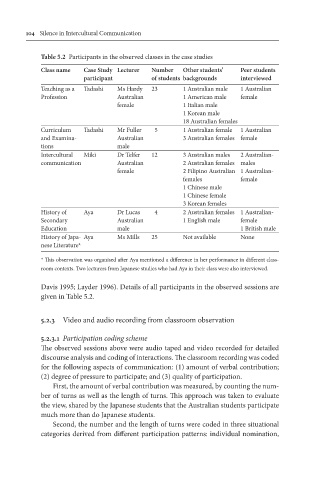
             Table 5.2  Participants in the observed classes in the case studies

             Class name  Case Study  Lecturer  Number   Other students’  Peer students
                         participant        of students backgrounds  interviewed
             Teaching as a   Tadashi  Ms Hardy   23  1 Australian male  1 Australian
             Profession           Australian         1 American male  female
                                  female             1 Italian male
                                                     1 Korean male
                                                     18 Australian females
             Curriculum   Tadashi  Mr Fuller     5   1 Australian female  1 Australian
             and Examina-         Australian         3 Australian females female
             tions                male
             Intercultural   Miki  Dr Telfer   12    3 Australian males  2 Australian-
             communication        Australian         2 Australian females males
                                  female             2 Filipino Australian  1 Australian-
                                                     females         female
                                                     1 Chinese male
                                                     1 Chinese female
                                                     3 Korean females
             History of   Aya     Dr Lucas     4     2 Australian females 1 Australian-
             Secondary            Australian         1 English male  female
             Education            male                               1 British male
             History of Japa- Aya  Ms Mills  25      Not available   None
             nese Literature*
             * This observation was organised after Aya mentioned a difference in her performance in different class-
             room contexts. Two lecturers from Japanese studies who had Aya in their class were also interviewed.

             Davis 1995; Layder 1996). Details of all participants in the observed sessions are
             given in Table 5.2.


             5.2.3  Video and audio recording from classroom observation

             5.2.3.1  Participation coding scheme
             The observed sessions above were audio taped and video recorded for detailed
             discourse analysis and coding of interactions. The classroom recording was coded
             for the following aspects of communication: (1) amount of verbal contribution;
             (2) degree of pressure to participate; and (3) quality of participation.
                First, the amount of verbal contribution was measured, by counting the num-
             ber of turns as well as the length of turns. This approach was taken to evaluate
             the view, shared by the Japanese students that the Australian students participate
             much more than do Japanese students.
                Second, the number and the length of turns were coded in three situational
             categories derived from different participation patterns: individual nomination,

