


Page 121 - Silence in Intercultural Communication
P. 121
108  Silence in Intercultural Communication


             spoke only twice, on both occasions after being selected by the teacher. The aver-
             age length of his turns was 1.5 seconds. Although the class, with 22 students, was
             large, extremely active involvement on the part of other students was observed
             throughout each of the two sessions. Overlapping, interruption and competition
             for the floor were frequently observed, and humour and jokes from the students
             were common. Tadashi, however, was an observer and did not attempt to jump
             into the class discussion at all. This was reflected in his interview comments which
             included, “I normally just listen, thinking, ‘Right, right’” or “Generally I am on the
             side of listening, sometimes feeling amused, ‘Hah hah, that’s funny.’” In both of the
             two observed sessions, the students worked in pairs to discuss how they would
             cope with hypothetical problematic situations in the profession of teaching. The
             students were given about ten to fifteen minutes to discuss the situations in pairs,
             and the teacher asked each pair to report their solution to the class. The class was
             then invited to comment on the solutions. In the first session observed, it was
             Tadashi’s partner in the pair work who told the class what they had discussed, and
             Tadashi did not speak during the class at all.
                In the second session of Teaching as a Profession, it was again Tadashi’s part-
             ner who initiated a comment. This time, however, Tadashi added a short com-
             ment, which was followed by the teacher’s request for him to repeat. Although
             Tadashi spoke in this session, his contribution was significantly smaller than most
             other students.
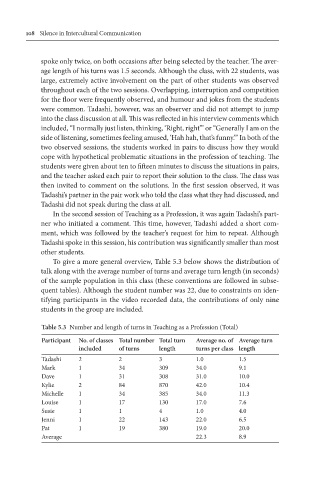
                To give a more general overview, Table 5.3 below shows the distribution of
             talk along with the average number of turns and average turn length (in seconds)
             of the sample population in this class (these conventions are followed in subse-
             quent tables). Although the student number was 22, due to constraints on iden-
             tifying participants in the video recorded data, the contributions of only nine
             students in the group are included.

             Table 5.3  Number and length of turns in Teaching as a Profession (Total)

             Participant  No. of classes  Total number  Total turn   Average no. of  Average turn
                       included    of turns   length     turns per class length
             Tadashi   2           2          3          1.0         1.5
             Mark      1           34         309        34.0        9.1
             Dave      1           31         308        31.0        10.0
             Kylie     2           84         870        42.0        10.4
             Michelle  1           34         385        34.0        11.3
             Louise    1           17         130        17.0        7.6
             Susie     1           1          4          1.0         4.0
             Jenni     1           22         143        22.0        6.5
             Pat       1           19         380        19.0        20.0
             Average                                     22.3        8.9

