


Page 116 - Silence in Intercultural Communication
P. 116
Chapter 5.  Performance and perceptions of silence  103


             5.2   Methodology of the case studies

             5.2.1  Japanese participants


             Three Japanese students, who will be referred to as Tadashi (male), Miki (female)
             and Aya (female), and who were studying in mainstream programs at the Univer-
             sity of Sydney, participated in the case studies. Tadashi and Aya also participated
             in the ethnographic interviews discussed in Chapter 4. Information relevant to
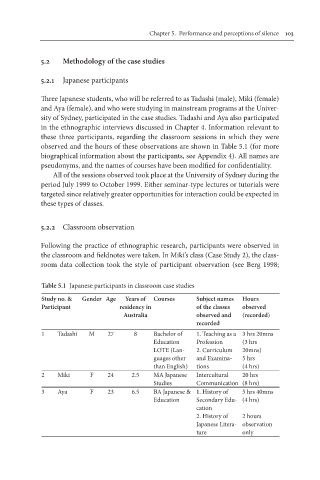
             these  three  participants,  regarding  the  classroom  sessions  in  which  they  were
             observed and the hours of these observations are shown in Table 5.1 (for more
             biographical information about the participants, see Appendix 4). All names are
             pseudonyms, and the names of courses have been modified for confidentiality.
                All of the sessions observed took place at the University of Sydney during the
             period July 1999 to October 1999. Either seminar-type lectures or tutorials were
             targeted since relatively greater opportunities for interaction could be expected in
             these types of classes.


             5.2.2  Classroom observation

             Following the practice of ethnographic research, participants were observed in
             the classroom and fieldnotes were taken. In Miki’s class (Case Study 2), the class-
             room data collection took the style of participant observation (see Berg 1998;


             Table 5.1  Japanese participants in classroom case studies
             Study no. &   Gender Age  Years of   Courses  Subject names   Hours
             Participant           residency in          of the classes   observed
                                    Australia            observed and   (recorded)
                                                         recorded
             1   Tadashi  M     27     8     Bachelor of   1. Teaching as a  3 hrs 20mns
                                             Education   Profession   (3 hrs
                                             LOTE (Lan-  2. Curriculum   20mns)
                                             guages other   and Examina-  5 hrs
                                             than English)  tions     (4 hrs)
             2   Miki      F    24    2.5    MA Japanese   Intercultural   20 hrs
                                             Studies     Communication (8 hrs)
             3   Aya       F    23    6.5    BA Japanese &  1. History of   5 hrs 40mns
                                             Education   Secondary Edu- (4 hrs)
                                                         cation
                                                         2. History of   2 hours
                                                         Japanese Litera- observation
                                                         ture         only

