


Page 196 - Silence in Intercultural Communication
P. 196
Chapter 5.  Performance and perceptions of silence  183


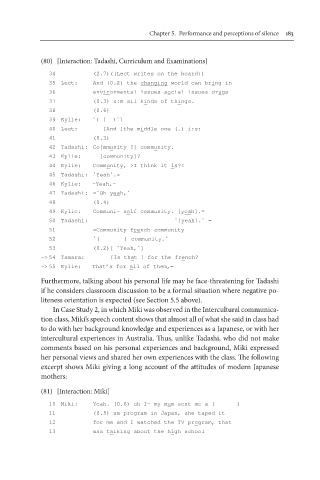
             (80)   [Interaction: Tadashi, Curriculum and Examinations]

             	 	34										(2.7)((Lect	writes	on	the	board))
             	 	35		Lect:				And	(0.2)	the	changing	world	can	bring	in
             	 	36										environmental	issues	social	issues	drugs
             	 	37										(0.3)	u:m	all	kinds	of	things.
             	 	38										(0.6)
                39  Kylie:   ˚( [  )˚]
             	 	40		Lect:									[And	]the	middle	one	(.)	i:s:
             	 	41										(0.3)
             	 	42		Tadashi:		Co[mmunity	?]	community.
             	 	43		Kylie:								[community]?
             	 	44		Kylie:			Community,	>I	think	it	is?<
                45  Tadashi:  ˚Yeah˚.=
             	 	46		Kylie:			=Yeah,=
                47  Tadashi:  =˚Oh yeah,˚
             	 	48										(0.4)
             	 	49		Kylie:			Communi-	self	community.	[yeah].=
                50  Tadashi:                        ˚[yeah].˚ =
             	 	51										=Community	french	community
                52          ˚(       ) community.˚
                53          (0.2)[ ˚Yeah,˚]
             ->	54		Tamara:									[Is	that	]	for	the	french?
             ->	55		Kylie:			That’s	for	all	of	them,=
             Furthermore, talking about his personal life may be face-threatening for Tadashi
             if he considers classroom discussion to be a formal situation where negative po-
             liteness orientation is expected (see Section 5.5 above).
                In Case Study 2, in which Miki was observed in the Intercultural communica-
             tion class, Miki’s speech content shows that almost all of what she said in class had
             to do with her background knowledge and experiences as a Japanese, or with her
             intercultural experiences in Australia. Thus, unlike Tadashi, who did not make
             comments based on his personal experiences and background, Miki expressed
             her personal views and shared her own experiences with the class. The following
             excerpt shows Miki giving a long account of the attitudes of modern Japanese
             mothers:
             (81)   [Interaction: Miki]

             	 	10		Miki:				Yeah.	(0.6)	uh	I-	my	mum	sent	me	a	(						)
             	 	11										(0.5)	um	program	in	Japan,	she	taped	it
             	 	12										for	me	and	I	watched	the	TV	program,	that
             	 	13										was	talking	about	the	high	school

