


Page 191 - Silence in Intercultural Communication
P. 191
178  Silence in Intercultural Communication


             there seem to be topics which Australian students regularly introduce but Japa-
             nese students do not. Personal and everyday life experiences, often contributed to
             classroom discussions by Australian students,  were noted by Japanese students to
             be missing in their notion of ‘classroom discussion.’ This difference may contrib-
             ute to Japanese student silences. However, the Japanese participants’ performance
             in the case studies revealed a different picture. Although it was found that silence
             could emerge from the absence of talk on specific topics, preferred and dispre-
             ferred topics of the three Japanese students appeared to vary.
                In the sessions observed in Case Study 1, which were all in the field of edu-
             cation, it appeared that students were allowed or encouraged to share their own
             experiences as a student or a trainee teacher, since they had already had their
             teaching practicum in that year and were about to enter the teaching profession.
             Therefore, comments such as “I remember in my prac,...” or “In my school, ...”
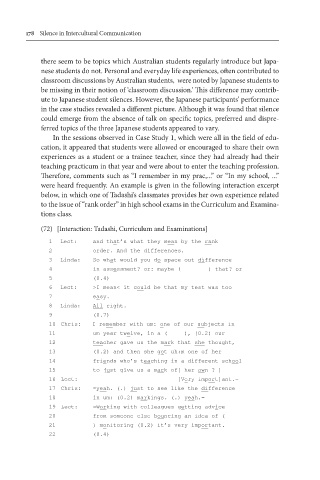
             were heard frequently. An example is given in the following interaction excerpt
             below, in which one of Tadashi’s classmates provides her own experience related
             to the issue of “rank order” in high school exams in the Curriculum and Examina-
             tions class.

             (72)   [Interaction: Tadashi, Curriculum and Examinations]
             	 	1			Lect:				and	that’s	what	they	mean	by	the	rank
             	 	2											order.	And	the	differences.
             	 	3			Linda:				So	what	would	you	do	space	out	difference
             	 	4											in	assessment?	or:	maybe	(							)	that?	or
             	 	5											(0.4)
             	 	6			Lect:				>I	mean<	it	could	be	that	my	test	was	too
             	 	7											easy.
             	 	8			Linda:				All	right.
             	 	9											(0.7)
             	 	10		Chris:			I	remember	with	um:	one	of	our	subjects	in
             	 	11										um	year	twelve,	in	a	(					),	(0.2)	our
             	 	12										teacher	gave	us	the	mark	that	she	thought,
             	 	13										(0.2)	and	then	she	got	uh:m	one	of	her
             	 	14										friends	who’s	teaching	in	a	different	school
             	 	15										to	just	give	us	a	mark	of[	her	own	?	]
             	 	16		Lect:																										[Very	import]ant.=
             	 	17		Chris:			=yeah.	(.)	just	to	see	like	the	difference
             	 	18										in	um:	(0.2)	markings.	(.)	yeah.=
             	 	19		Lect:				=Working	with	colleagues	getting	advice
             	 	20										from	someone	else	bouncing	an	idea	of	(
             	 	21										)	monitoring	(0.2)	it’s	very	important.
             	 	22										(0.4)

