


Page 186 - Silence in Intercultural Communication
P. 186
Chapter 5.  Performance and perceptions of silence  173


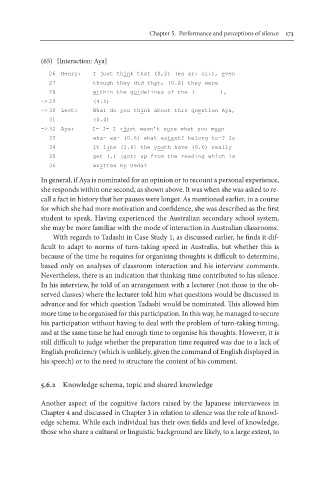
             (65)   [Interaction: Aya]

             	 	26		Henry:			I	just	think	that	(0,2)	(es	ar:	ci:),	even
             	 	27										though	they	did	that,	(0.2)	they	were
             	 	28										within	the	guidelines	of	the	(							),
             ->	29										(4.5)
             ->	30		Lect:				What	do	you	think	about	this	question	Aya,
             	 	31										(0.4)
             -> 32  Aya:     I- I- I ↑just	wasn’t	sure	what	you	mean
             	 	33										wha-	ex-	(0.6)	what	extent?	belong	to-?	Is
             	 	34										it	like	(1.6)	the	youth	have	(0.6)	really
             	 	35										get	(.)	(got)	up	from	the	reading	which	is
             	 	36										written	by	Ueda?
             In general, if Aya is nominated for an opinion or to recount a personal experience,
             she responds within one second, as shown above. It was when she was asked to re-
             call a fact in history that her pauses were longer. As mentioned earlier, in a course
             for which she had more motivation and confidence, she was described as the first
             student to speak. Having experienced the Australian secondary school system,
             she may be more familiar with the mode of interaction in Australian classrooms.
                With regards to Tadashi in Case Study 1, as discussed earlier, he finds it dif-
             ficult to adapt to norms of turn-taking speed in Australia, but whether this is
             because of the time he requires for organising thoughts is difficult to determine,
             based only on analyses of classroom interaction and his interview comments.
             Nevertheless, there is an indication that thinking time contributed to his silence.
             In his interview, he told of an arrangement with a lecturer (not those in the ob-
             served classes) where the lecturer told him what questions would be discussed in
             advance and for which question Tadashi would be nominated. This allowed him
             more time to be organised for this participation. In this way, he managed to secure
             his participation without having to deal with the problem of turn-taking timing,
             and at the same time he had enough time to organise his thoughts. However, it is
             still difficult to judge whether the preparation time required was due to a lack of
             English proficiency (which is unlikely, given the command of English displayed in
             his speech) or to the need to structure the content of his comment.


             5.6.2  Knowledge schema, topic and shared knowledge

             Another aspect of the cognitive factors raised by the Japanese interviewees in
             Chapter 4 and discussed in Chapter 3 in relation to silence was the role of knowl-
             edge schema. While each individual has their own fields and level of knowledge,
             those who share a cultural or linguistic background are likely, to a large extent, to

