


Page 185 - Silence in Intercultural Communication
P. 185
172  Silence in Intercultural Communication


             familiarity with coming up with ideas or organising thoughts in a short period of
             time. The first two of these were observed in the case studies to some degree, as
             discussed earlier. The last has not been discussed in detail, and will be addressed
             below with data from the case studies. Among the three Japanese participants,
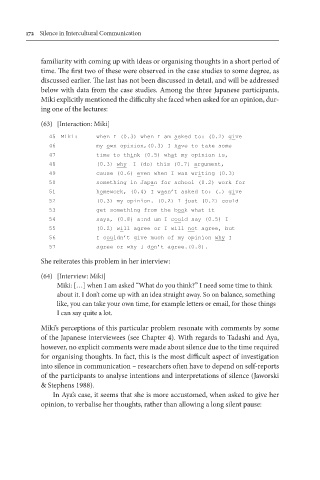
             Miki explicitly mentioned the difficulty she faced when asked for an opinion, dur-
             ing one of the lectures:

             (63)   [Interaction: Miki]

             	 	45		Miki:					when	I	(0.3)	when	I	am	asked	to:	(0.2)	give
             	 	46											my	own	opinion,(0.3)	I	have	to	take	some
             	 	47											time	to	think	(0.5)	what	my	opinion	is,
             	 	48											(0.3)	why		I	(do)	this	(0.7)	argument,
             	 	49											cause	(0.6)	even	when	I	was	writing	(0.3)
             	 	50											something	in	Japan	for	school	(0.2)	work	for
             	 	51											homework,	(0.4)	I	wasn’t	asked	to:	(.)	give
             	 	52											(0.3)	my	opinion.	(0.2)	I	just	(0.2)	could
             	 	53											get	something	from	the	book	what	it
             	 	54											says,	(0.8)	a:nd	um	I	could	say	(0.5)	I
             	 	55											(0.2)	will	agree	or	I	will	not	agree,	but
             	 	56											I	couldn’t	give	much	of	my	opinion	why	I
             	 	57											agree	or	why	I	don’t	agree.(0.8).
             She reiterates this problem in her interview:

             (64)   [Interview: Miki]
                     Miki: […] when I am asked “What do you think?” I need some time to think
                     about it. I don’t come up with an idea straight away. So on balance, something
                     like, you can take your own time, for example letters or email, for those things
                     I can say quite a lot.

             Miki’s perceptions of this particular problem resonate with comments by some
             of the Japanese interviewees (see Chapter 4). With regards to Tadashi and Aya,
             however, no explicit comments were made about silence due to the time required
             for organising thoughts. In fact, this is the most difficult aspect of investigation
             into silence in communication – researchers often have to depend on self-reports
             of the participants to analyse intentions and interpretations of silence (Jaworski
             & Stephens 1988).
                In Aya’s case, it seems that she is more accustomed, when asked to give her
             opinion, to verbalise her thoughts, rather than allowing a long silent pause:

