


Page 432 -
P. 432
17 Social Constraint                                            435

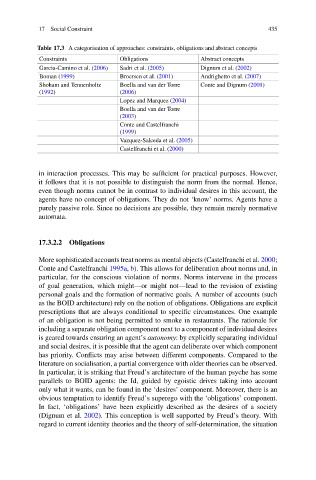
           Table 17.3 A categorisation of approaches: constraints, obligations and abstract concepts
            Constraints           Obligations            Abstract concepts
            Garcia-Camino et al. (2006)  Sadri et al. (2005)  Dignum et al. (2002)
            Boman (1999)          Broersen et al. (2001)  Andrighetto et al. (2007)
            Shoham and Tennenholtz  Boella and van der Torre  Conte and Dignum (2001)
            (1992)                (2006)
                                  Lopez and Marquez (2004)
                                  Boella and van der Torre
                                  (2003)
                                  Conte and Castelfranchi
                                  (1999)
                                  Vazquez-Salceda et al. (2005)
                                  Castelfranchi et al. (2000)


            in interaction processes. This may be sufficient for practical purposes. However,
            it follows that it is not possible to distinguish the norm from the normal. Hence,
            even though norms cannot be in contrast to individual desires in this account, the
            agents have no concept of obligations. They do not ‘know’ norms. Agents have a
            purely passive role. Since no decisions are possible, they remain merely normative
            automata.


            17.3.2.2  Obligations

            More sophisticated accounts treat norms as mental objects (Castelfranchi et al. 2000;
            Conte and Castelfranchi 1995a, b). This allows for deliberation about norms and, in
            particular, for the conscious violation of norms. Norms intervene in the process
            of goal generation, which might—or might not—lead to the revision of existing
            personal goals and the formation of normative goals. A number of accounts (such
            as the BOID architecture) rely on the notion of obligations. Obligations are explicit
            prescriptions that are always conditional to specific circumstances. One example
            of an obligation is not being permitted to smoke in restaurants. The rationale for
            including a separate obligation component next to a component of individual desires
            is geared towards ensuring an agent’s autonomy: by explicitly separating individual
            and social desires, it is possible that the agent can deliberate over which component
            has priority. Conflicts may arise between different components. Compared to the
            literature on socialisation, a partial convergence with older theories can be observed.
            In particular, it is striking that Freud’s architecture of the human psyche has some
            parallels to BOID agents: the Id, guided by egoistic drives taking into account
            only what it wants, can be found in the ‘desires’ component. Moreover, there is an
            obvious temptation to identify Freud’s superego with the ‘obligations’ component.
            In fact, ‘obligations’ have been explicitly described as the desires of a society
            (Dignum et al. 2002). This conception is well supported by Freud’s theory. With
            regard to current identity theories and the theory of self-determination, the situation

