


Page 144 - Social Marketing for Public Health Global Trends and Success Stories
P. 144
57977_CH05_final.qxd:Cheng  11/5/09  4:38 PM  Page 117


                                                                          Marketing Mix Strategy  117


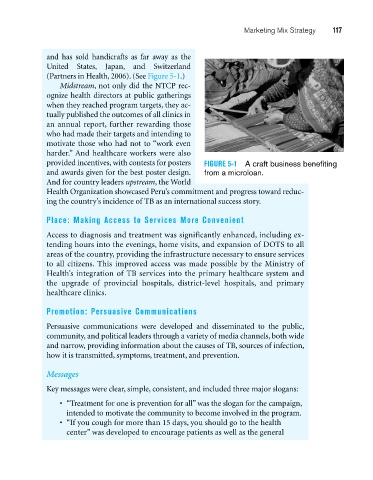
                     and has sold handicrafts as far away as the
                     United States, Japan, and Switzerland
                     (Partners in Health, 2006). (See Figure 5-1.)
                        Midstream, not only did the NTCP rec-
                     ognize health directors at public gatherings
                     when they reached program targets, they ac-
                     tually published the outcomes of all clinics in
                     an annual report, further rewarding those
                     who had made their targets and intending to
                     motivate those who had not to “work even
                     harder.” And healthcare workers were also
                     provided incentives, with contests for posters  FIGURE 5-1 A craft business benefiting
                     and awards given for the best poster design.  from a microloan.
                     And for country leaders upstream, the World
                     Health Organization showcased Peru’s commitment and progress toward reduc-
                     ing the country’s incidence of TB as an international success story.

                     Place: Making Access to Services More Convenient

                     Access to diagnosis and treatment was significantly enhanced, including ex-
                     tending hours into the evenings, home visits, and expansion of DOTS to all
                     areas of the country, providing the infrastructure necessary to ensure services
                     to all citizens. This improved access was made possible by the Ministry of
                     Health’s integration of TB services into the primary healthcare system and
                     the upgrade of provincial hospitals, district-level hospitals, and primary
                     healthcare clinics.

                     Promotion: Persuasive Communications

                     Persuasive communications were developed and disseminated to the public,
                     community, and political leaders through a variety of media channels, both wide
                     and narrow, providing information about the causes of TB, sources of infection,
                     how it is transmitted, symptoms, treatment, and prevention.

                     Messages

                     Key messages were clear, simple, consistent, and included three major slogans:
                        • “Treatment for one is prevention for all” was the slogan for the campaign,
                          intended to motivate the community to become involved in the program.
                        • “If you cough for more than 15 days, you should go to the health
                          center” was developed to encourage patients as well as the general

