


Page 148 - Social Marketing for Public Health Global Trends and Success Stories
P. 148
57977_CH05_final.qxd:Cheng  11/5/09  4:39 PM  Page 121


                                                                                   Partnerships   121


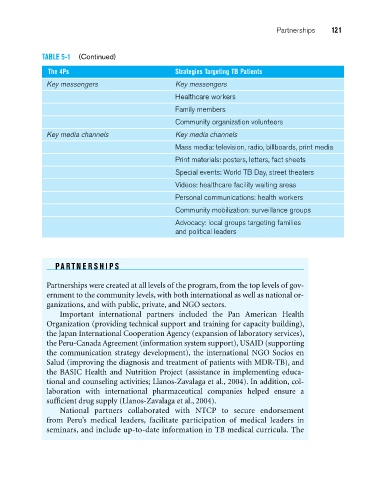
                    TABLE 5-1  (Continued)
                     The 4Ps                            Strategies Targeting TB Patients
                     Key messengers                     Key messengers
                                                        Healthcare workers
                                                        Family members

                                                        Community organization volunteers
                     Key media channels                 Key media channels
                                                        Mass media: television, radio, billboards, print media
                                                        Print materials: posters, letters, fact sheets
                                                        Special events: World TB Day, street theaters
                                                        Videos: healthcare facility waiting areas
                                                        Personal communications: health workers

                                                        Community mobilization: surveillance groups
                                                        Advocacy: local groups targeting families
                                                        and political leaders


                       PA R TNER S HIP S

                     Partnerships were created at all levels of the program, from the top levels of gov-
                     ernment to the community levels, with both international as well as national or-
                     ganizations, and with public, private, and NGO sectors.
                        Important international partners included the Pan  American Health
                     Organization (providing technical support and training for capacity building),
                     the Japan International Cooperation Agency (expansion of laboratory services),
                     the Peru-Canada Agreement (information system support), USAID (supporting
                     the communication strategy development), the international NGO Socios en
                     Salud (improving the diagnosis and treatment of patients with MDR-TB), and
                     the BASIC Health and Nutrition Project (assistance in implementing educa-
                     tional and counseling activities; Llanos-Zavalaga et al., 2004). In addition, col-
                     laboration with international pharmaceutical companies helped ensure a
                     sufficient drug supply (Llanos-Zavalaga et al., 2004).
                        National partners collaborated with NTCP to secure endorsement
                     from Peru’s medical leaders, facilitate participation of medical leaders in
                     seminars, and include up-to-date information in TB medical curricula. The

