


Page 184 -
P. 184
6.4   Application architectures  167


                                            Input                    Process                   Output

                                         Get Customer                                        Print Details
                                          Account ID
                                                                   Query Account

                                         Validate Card                                       Return Card

                                                                  Update Account

                                         Select Service                                     Dispense Cash
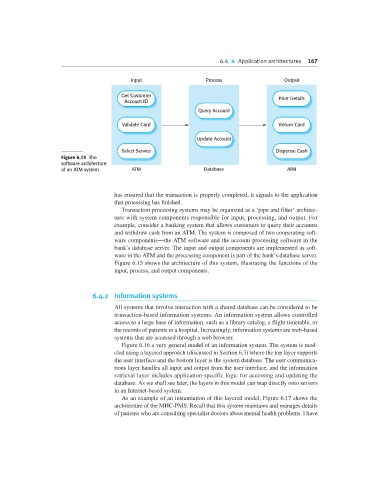
                     Figure 6.15 The
                     software architecture
                     of an ATM system        ATM                     Database                   ATM


                                       has ensured that the transaction is properly completed, it signals to the application
                                       that processing has finished.
                                         Transaction processing systems may be organized as a ‘pipe and filter’ architec-
                                       ture with system components responsible for input, processing, and output. For
                                       example, consider a banking system that allows customers to query their accounts
                                       and withdraw cash from an ATM. The system is composed of two cooperating soft-
                                       ware components—the ATM software and the account processing software in the
                                       bank’s database server. The input and output components are implemented as soft-
                                       ware in the ATM and the processing component is part of the bank’s database server.
                                       Figure 6.15 shows the architecture of this system, illustrating the functions of the
                                       input, process, and output components.


                                6.4.2 Information systems

                                       All systems that involve interaction with a shared database can be considered to be
                                       transaction-based information systems. An information system allows controlled
                                       access to a large base of information, such as a library catalog, a flight timetable, or
                                       the records of patients in a hospital. Increasingly, information systems are web-based
                                       systems that are accessed through a web browser.
                                         Figure 6.16 a very general model of an information system. The system is mod-
                                       eled using a layered approach (discussed in Section 6.3) where the top layer supports
                                       the user interface and the bottom layer is the system database. The user communica-
                                       tions layer handles all input and output from the user interface, and the information
                                       retrieval layer includes application-specific logic for accessing and updating the
                                       database. As we shall see later, the layers in this model can map directly onto servers
                                       in an Internet-based system.
                                         As an example of an instantiation of this layered model, Figure 6.17 shows the
                                       architecture of the MHC-PMS. Recall that this system maintains and manages details
                                       of patients who are consulting specialist doctors about mental health problems. I have

