


Page 330 -
P. 330
CHAPTER 12  ANALYSIS MODELING                                      301

                                By the mid-1980s, real-time "extensions" were introduced by Ward and Mellor
                              [WAR85] and later by Hatley and Pirbhai [HAT87]. These extensions resulted in a more
                              robust analysis method that could be applied effectively to engineering problems.
                              Attempts to develop one consistent notation have been suggested [BRU88], and mod-
                              ernized treatments have been published to accommodate the use of CASE tools
                              [YOU89].


                      12.2    THE ELEMENTS OF THE ANALYSIS MODEL

                              The analysis model must achieve three primary objectives: (1) to describe what the
                              customer requires, (2) to establish a basis for the creation of a software design, and
                              (3) to define a set of requirements that can be validated once the software is built. To
                              accomplish these objectives, the analysis model derived during structured analysis
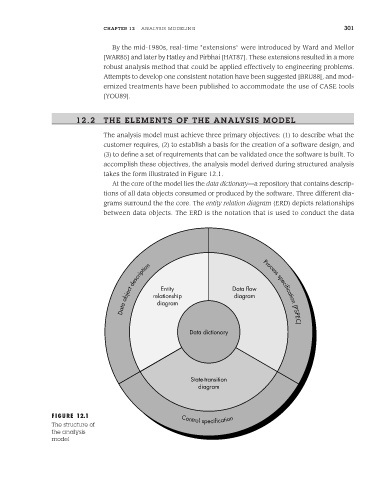
                              takes the form illustrated in Figure 12.1.
                                At the core of the model lies the data dictionary—a repository that contains descrip-
                              tions of all data objects consumed or produced by the software. Three different dia-
                              grams surround the the core. The entity relation diagram (ERD) depicts relationships
                              between data objects. The ERD is the notation that is used to conduct the data


                                      description                         Process specification


                                    object  relationship          Data flow
                                              Entity
                                                                  diagram
                                   Data      diagram                              (PSPEC)


                                                      Data dictionary


                                                      State-transition
                                                        diagram


               FIGURE 12.1                         Control specification
               The structure of
               the analysis
               model

