


Page 335 -
P. 335
306           PART THREE  CONVENTIONAL METHODS FOR SOFTWARE ENGINEERING


                       Cardinality is the specification of the number of occurrences of one [object] that can be
                       related to the number of occurrences of another [object]. Cardinality is usually expressed
                       as simply 'one' or 'many.' For example, a husband can have only one wife (in most cul-
                       tures), while a parent can have many children. Taking into consideration all combinations
                       of 'one' and 'many,' two [objects] can be related as
                       •  One-to-one (l:l)—An occurrence of [object] 'A' can relate to one and only one occur-
                          rence of [object] 'B,' and an occurrence of 'B' can relate to only one occurrence of 'A.'
                       •  One-to-many (l:N)—One occurrence of [object] 'A' can relate to one or many occur-
                          rences of [object] 'B,' but an occurrence of 'B' can relate to only one occurrence of 'A.'
                          For example, a mother can have many children, but a child can have only one mother.
                       •  Many-to-many (M:N)—An occurrence of [object] 'A' can relate to one or more occur-
                          rences of 'B,' while an occurrence of 'B' can relate to one or more occurrences of 'A.'
                          For example, an uncle can have many nephews, while a nephew can have many uncles.
                       Cardinality defines “the maximum number of objects that can participate in a rela-
                       tionship” [TIL93]. It does not, however, provide an indication of whether or not a par-
                       ticular data object must participate in the relationship. To specify this information,
                       the data model adds modality to the object/relationship pair.


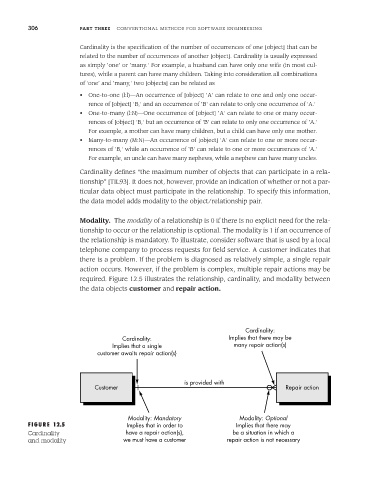
                       Modality. The modality of a relationship is 0 if there is no explicit need for the rela-
                       tionship to occur or the relationship is optional. The modality is 1 if an occurrence of
                       the relationship is mandatory. To illustrate, consider software that is used by a local
                       telephone company to process requests for field service. A customer indicates that
                       there is a problem. If the problem is diagnosed as relatively simple, a single repair
                       action occurs. However, if the problem is complex, multiple repair actions may be
                       required. Figure 12.5 illustrates the relationship, cardinality, and modality between
                       the data objects customer and repair action.


                                                                     Cardinality:
                                   Cardinality:                  Implies that there may be
                                Implies that a single             many repair action(s)
                            customer awaits repair action(s)


                                                    is provided with
                           Customer                                             Repair action


                                     Modality: Mandatory            Modality: Optional
         FIGURE 12.5                Implies that in order to       Implies that there may
         Cardinality                have a repair action(s),      be a situation in which a
         and modality              we must have a customer      repair action is not necessary

