


Page 339 -
P. 339
310           PART THREE  CONVENTIONAL METHODS FOR SOFTWARE ENGINEERING


                    External  Input data                                            External
                     entity                                                          entity
                                              Intermediate
                                     Transform   data
                                       #1
                                                      Transform  Intermediate      Output data
                                                         #3        data
                                            Intermediate
                                              data
                                                                        Transform
                                                                          #4
                                                 Data store  Data store
                                      Transform    input     output
                    External             #2
                     entity                           Data store                   Output data
                              Input data

                                                                                    External
                                                                                     entity
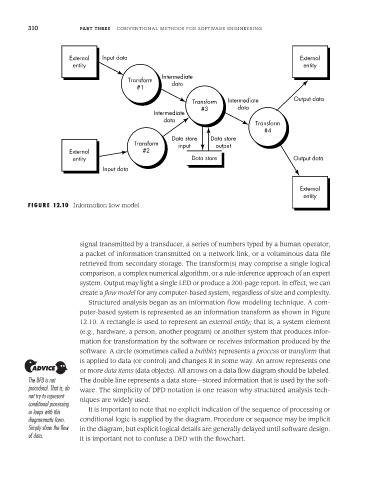
         FIGURE 12.10 Information flow model


                       signal transmitted by a transducer, a series of numbers typed by a human operator,
                       a packet of information transmitted on a network link, or a voluminous data file
                       retrieved from secondary storage. The transform(s) may comprise a single logical
                       comparison, a complex numerical algorithm, or a rule-inference approach of an expert
                       system. Output may light a single LED or produce a 200-page report. In effect, we can
                       create a flow model for any computer-based system, regardless of size and complexity.
                          Structured analysis began as an information flow modeling technique. A com-
                       puter-based system is represented as an information transform as shown in Figure
                       12.10. A rectangle is used to represent an external entity; that is, a system element
                       (e.g., hardware, a person, another program) or another system that produces infor-
                       mation for transformation by the software or receives information produced by the
                       software. A circle (sometimes called a bubble) represents a process or transform that
                       is applied to data (or control) and changes it in some way. An arrow represents one
                       or more data items (data objects). All arrows on a data flow diagram should be labeled.
         The DFD is not  The double line represents a data store—stored information that is used by the soft-
         procedural. That is, do  ware. The simplicity of DFD notation is one reason why structured analysis tech-
         not try to represent
         conditional processing  niques are widely used.
         or loops with this  It is important to note that no explicit indication of the sequence of processing or
         diagrammatic form.  conditional logic is supplied by the diagram. Procedure or sequence may be implicit
         Simply show the flow  in the diagram, but explicit logical details are generally delayed until software design.
         of data.
                       It is important not to confuse a DFD with the flowchart.

