


Page 343 -
P. 343
314           PART THREE  CONVENTIONAL METHODS FOR SOFTWARE ENGINEERING


         FIGURE 12.13                                            Movement
         Data and         Status of each                          alarm
         control flows        fixture
         using Ward
         and Mellor      Parts status buffer            Robot
         notation                                      initiation
         [WAR85]                             Start/stop  control
                             Bit string
                                               flag
                                        Monitor                Process
                                        fixture &             activate
                                        operator
                                        interface
                                                                      Position
                         Operator               Operator
                        commands                 settings  Process   commands
                                                            robot
                                                          commands

                                                     Robot movement
                                                        record
                                         Robot command file


                       representation of control flow from the data flow diagram. This exclusion is overly
                       restrictive when real-time applications are considered, and for this reason, a spe-
                       cialized notation for representing event flows and control processing has been devel-
                       oped.  Continuing the convention established for data flow diagrams, data flow is
                       represented using a solid arrow. Control flow, however, is represented using a dashed
                       or shaded arrow. A process that handles only control flows, called a control process,
                       is similarly represented using a dashed bubble.
                          Control flow can be input directly to a conventional process or into a control process.
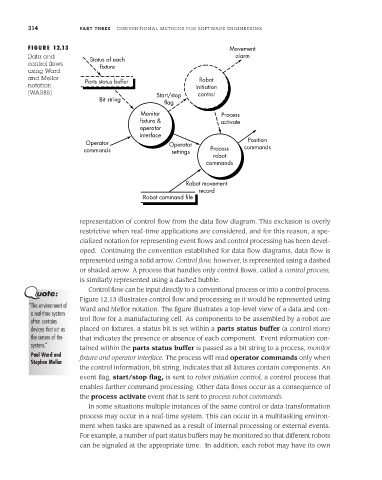
                       Figure 12.13 illustrates control flow and processing as it would be represented using
         “The environment of  Ward and Mellor notation. The figure illustrates a top-level view of a data and con-
          a real-time system
          often contains  trol flow for a manufacturing cell. As components to be assembled by a robot are
          devices that act as  placed on fixtures, a status bit is set within a parts status buffer (a control store)
          the senses of the  that indicates the presence or absence of each component.  Event information con-
          system.”
                       tained within the parts status buffer is passed as a bit string to a process, monitor
          Paul Ward and  fixture and operator interface. The process will read operator commands only when
          Stephen Mellor
                       the control information, bit string, indicates that all fixtures contain components. An
                       event flag, start/stop flag, is sent to robot initiation control, a control process that
                       enables further command processing. Other data flows occur as a consequence of
                       the process activate event that is sent to process robot commands.
                          In some situations multiple instances of the same control or data transformation
                       process may occur in a real-time system. This can occur in a multitasking environ-
                       ment when tasks are spawned as a result of internal processing or external events.
                       For example, a number of part status buffers may be monitored so that different robots
                       can be signaled at the appropriate time.  In addition, each robot may have its own

