


Page 346 -
P. 346
CHAPTER 12  ANALYSIS MODELING                                      317

                FIGURE 12.16   Paper feed status
                Level 1 CFD for  (jammed, empty)
                photocopier                       Alarm
                software
                                                                      Produce
                                    Start/stop                         user
                                                    Manage
                                                    copying           displays
                                    Read
                                   operator
                                     input

                                                                   Perform
                                                                   problem
                                                                   diagnosis
                                               Reload
                                               paper     Full

                                                                        Repro
                                                                         fault


                              processes are activated by a given event. For example, a process activation table (PAT)
                              for Figure 12.15 might indicate that the above pressure event would cause a process
                              reduce tank pressure (not shown) to be invoked. In addition to the PAT, the CSPEC may
                              contain a state transition diagram. The STD is a behavioral model that relies on the
                              definition of a set of system states and is described in the following section.


                      12.5    BEHAVIORAL MODELING

                              Behavioral modeling is an operational principle for all requirements analysis meth-
                              ods. Yet, only extended versions of structured analysis ([WAR85], [HAT87]) provide a
                ?  How do I   notation for this type of modeling. The state transition diagram represents the behav-
                   model the
                software’s    ior of a system by depicting its states and the events that cause the system to change
                reaction to some  state. In addition, the STD indicates what actions (e.g., process activation) are taken
                external event?
                              as a consequence of a particular event.
                                A state is any observable mode of behavior. For example, states for a monitoring
                              and control system for pressure vessels described in Section 12.4.4 might be moni-
                              toring state, alarm state, pressure release state, and so on. Each of these states repre-
                              sents a mode of behavior of the system. A state transition diagram indicates how the
                              system moves from state to state.
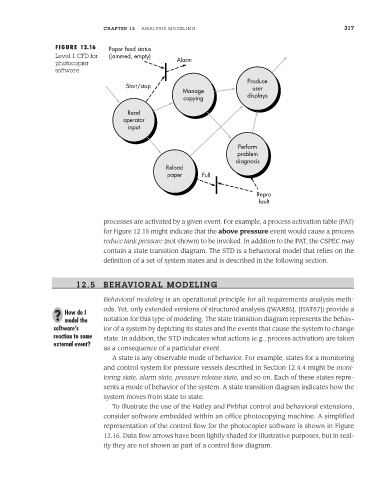
                                To illustrate the use of the Hatley and Pirbhai control and behavioral extensions,
                              consider software embedded within an office photocopying machine. A simplified
                              representation of the control flow for the photocopier software is shown in Figure
                              12.16. Data flow arrows have been lightly shaded for illustrative purposes, but in real-
                              ity they are not shown as part of a control flow diagram.

