


Page 342 -
P. 342
CHAPTER 12  ANALYSIS MODELING                                      313

               FIGURE 12.12    Monitored         Input
               Time-          temperature     “continuous”
               continuous                                        Output
               data flow                                       “continuous”
                                                     Monitor
                                                    and adjust               Corrected
                                                    temperature                value
                                                      level


                              Temperature
                               set point


                                •  Multiple instances of the same transformation are sometimes encountered in
                                   multitasking situations.

                                •  Systems have states and a mechanism causes transition between states.
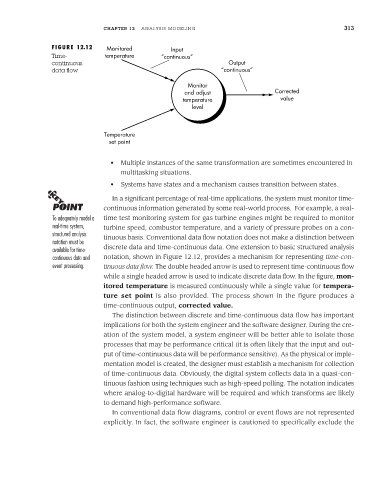
                                In a significant percentage of real-time applications, the system must monitor time-
                              continuous information generated by some real-world process.  For example, a real-
                To adequately model a  time test monitoring system for gas turbine engines might be required to monitor
                real-time system,  turbine speed, combustor temperature, and a variety of pressure probes on a con-
                structured analysis  tinuous basis. Conventional data flow notation does not make a distinction between
                notation must be
                available for time-  discrete data and time-continuous data. One extension to basic structured analysis
                continuous data and  notation, shown in Figure 12.12, provides a mechanism for representing time-con-
                event processing.  tinuous data flow. The double headed arrow is used to represent time-continuous flow
                              while a single headed arrow is used to indicate discrete data flow. In the figure, mon-
                              itored temperature is measured continuously while a single value for tempera-
                              ture set point is also provided. The process shown in the figure produces a
                              time-continuous output, corrected value.
                                The distinction between discrete and time-continuous data flow has important
                              implications for both the system engineer and the software designer. During the cre-
                              ation of the system model, a system engineer will be better able to isolate those
                              processes that may be performance critical (it is often likely that the input and out-
                              put of time-continuous data will be performance sensitive). As the physical or imple-
                              mentation model is created, the designer must establish a mechanism for collection
                              of time-continuous data. Obviously, the digital system collects data in a quasi-con-
                              tinuous fashion using techniques such as high-speed polling. The notation indicates
                              where analog-to-digital hardware will be required and which transforms are likely
                              to demand high-performance software.
                                In conventional data flow diagrams, control or event flows are not represented
                              explicitly. In fact, the software engineer is cautioned to specifically exclude the

