


Page 337 -
P. 337
308           PART THREE  CONVENTIONAL METHODS FOR SOFTWARE ENGINEERING


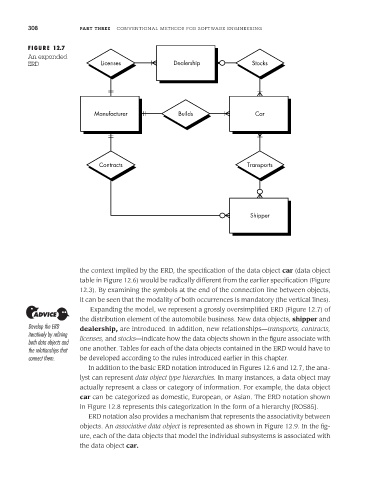
         FIGURE 12.7
         An expanded
         ERD                 Licenses            Dealership            Stocks


                           Manufacturer            Builds               Car


                             Contracts                                Transports


                                                                       Shipper


                       the context implied by the ERD, the specification of the data object car (data object
                       table in Figure 12.6) would be radically different from the earlier specification (Figure
                       12.3). By examining the symbols at the end of the connection line between objects,
                       it can be seen that the modality of both occurrences is mandatory (the vertical lines).
                          Expanding the model, we represent a grossly oversimplified ERD (Figure 12.7) of
                       the distribution element of the automobile business. New data objects, shipper and
         Develop the ERD  dealership, are introduced. In addition, new relationships—transports, contracts,
         iteratively by refining
         both data objects and  licenses, and stocks—indicate how the data objects shown in the figure associate with
         the relationships that  one another. Tables for each of the data objects contained in the ERD would have to
         connect them.  be developed according to the rules introduced earlier in this chapter.
                          In addition to the basic ERD notation introduced in Figures 12.6 and 12.7, the ana-
                       lyst can represent data object type hierarchies. In many instances, a data object may
                       actually represent a class or category of information. For example, the data object
                       car can be categorized as domestic, European, or Asian. The ERD notation shown
                       in Figure 12.8 represents this categorization in the form of a hierarchy [ROS85].
                          ERD notation also provides a mechanism that represents the associativity between
                       objects. An associative data object is represented as shown in Figure 12.9. In the fig-
                       ure, each of the data objects that model the individual subsystems is associated with
                       the data object car.

