


Page 332 -
P. 332
CHAPTER 12  ANALYSIS MODELING                                      303

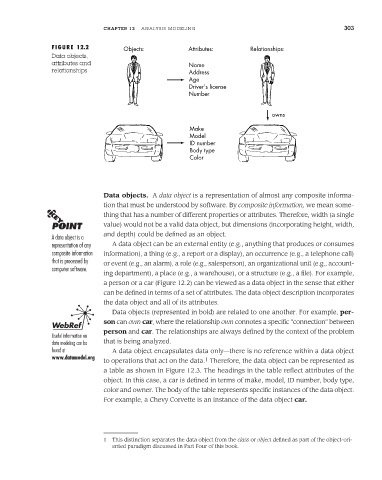
               FIGURE 12.2         Objects:          Attributes:       Relationships:
               Data objects,
               attributes and                        Name
               relationships                         Address
                                                     Age
                                                     Driver's license
                                                     Number

                                                                             owns

                                                      Make
                                                      Model
                                                      ID number
                                                      Body type
                                                      Color


                              Data objects. A data object is a representation of almost any composite informa-
                              tion that must be understood by software. By composite information, we mean some-
                              thing that has a number of different properties or attributes. Therefore, width (a single
                              value) would not be a valid data object, but dimensions (incorporating height, width,
                              and depth) could be defined as an object.
               A data object is a
               representation of any  A data object can be an external entity (e.g., anything that produces or consumes
               composite information  information), a thing (e.g., a report or a display), an occurrence (e.g., a telephone call)
               that is processed by  or event (e.g., an alarm), a role (e.g., salesperson), an organizational unit (e.g., account-
               computer software.
                              ing department), a place (e.g., a warehouse), or a structure (e.g., a file). For example,
                              a person or a car (Figure 12.2) can be viewed as a data object in the sense that either
                              can be defined in terms of a set of attributes. The data object description incorporates
                              the data object and all of its attributes.
                                Data objects (represented in bold) are related to one another. For example, per-
                              son can own car, where the relationship own connotes a specific "connection” between
               WebRef
                              person and car. The relationships are always defined by the context of the problem
               Useful information on
               data modeling can be  that is being analyzed.
               found at         A data object encapsulates data only—there is no reference within a data object
               www.datamodel.org                          1
                              to operations that act on the data. Therefore, the data object can be represented as
                              a table as shown in Figure 12.3. The headings in the table reflect attributes of the
                              object. In this case, a car is defined in terms of make, model, ID number, body type,
                              color and owner. The body of the table represents specific instances of the data object.
                              For example, a Chevy Corvette is an instance of the data object car.


                              1  This distinction separates the data object from the class or object defined as part of the object-ori-
                                ented paradigm discussed in Part Four of this book.

