


Page 336 -
P. 336
CHAPTER 12  ANALYSIS MODELING                                      307

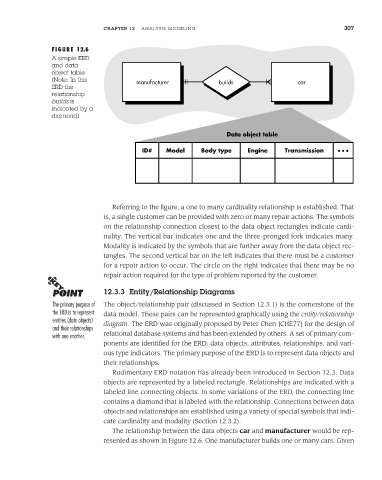
               FIGURE 12.6
               A simple ERD
               and data
               object table
               (Note: In this
                                       manufacturer           builds                car
               ERD the
               relationship
               builds is
               indicated by a
               diamond)

                                                                Data object table

                                        ID#    Model     Body type    Engine    Transmission   • • •


                                Referring to the figure, a one to many cardinality relationship is established. That
                              is, a single customer can be provided with zero or many repair actions. The symbols
                              on the relationship connection closest to the data object rectangles indicate cardi-
                              nality. The vertical bar indicates one and the three-pronged fork indicates many.
                              Modality is indicated by the symbols that are further away from the data object rec-
                              tangles. The second vertical bar on the left indicates that there must be a customer
                              for a repair action to occur. The circle on the right indicates that there may be no
                              repair action required for the type of problem reported by the customer.

                              12.3.3 Entity/Relationship Diagrams
                The primary purpose of  The object/relationship pair (discussed in Section 12.3.1) is the cornerstone of the
                the ERD is to represent  data model. These pairs can be represented graphically using the entity/relationship
                entities (data objects)  diagram. The ERD was originally proposed by Peter Chen [CHE77] for the design of
                and their relationships
                with one another.  relational database systems and has been extended by others. A set of primary com-
                              ponents are identified for the ERD: data objects, attributes, relationships, and vari-
                              ous type indicators. The primary purpose of the ERD is to represent data objects and
                              their relationships.
                                Rudimentary ERD notation has already been introduced in Section 12.3. Data
                              objects are represented by a labeled rectangle. Relationships are indicated with a
                              labeled line connecting objects. In some variations of the ERD, the connecting line
                              contains a diamond that is labeled with the relationship. Connections between data
                              objects and relationships are established using a variety of special symbols that indi-
                              cate cardinality and modality (Section 12.3.2).
                                The relationship between the data objects car and manufacturer would be rep-
                              resented as shown in Figure 12.6. One manufacturer builds one or many cars. Given

