


Page 340 -
P. 340
CHAPTER 12  ANALYSIS MODELING                                      311

                              12.4.1 Data Flow Diagrams
                              As information moves through software, it is modified by a series of transformations.
                              A data flow diagram is a graphical representation that depicts information flow and
                              the transforms that are applied as data move from input to output.  The basic form
                The DFD provides a
                mechanism for  of a data flow diagram, also known as a data flow graph or a bubble chart, is illus-
                information flow  trated in Figure 12.10.
                modeling and    The data flow diagram may be used to represent a system or software at any level
                functional modeling.
                              of abstraction. In fact, DFDs may be partitioned into levels that represent increasing
                              information flow and functional detail. Therefore, the DFD provides a mechanism for
                              functional modeling as well as information flow modeling. In so doing, it satisfies the
                              second operational analysis principle (i.e., creating a functional model) discussed in
                              Chapter 11.
                                A level 0 DFD, also called a fundamental system model or a context model, repre-
                              sents the entire software element as a single bubble with input and output data indi-
                              cated by incoming and outgoing arrows, respectively.  Additional processes (bubbles)
               Refinement from one  and information flow paths are represented as the level 0 DFD is partitioned to reveal
               DFD level to the next  more detail. For example, a level 1 DFD might contain five or six bubbles with inter-
               should follow an  connecting arrows. Each of the processes represented at level 1 is a subfunction of
               approximate 1:5 ratio,
               reducing as the  the overall system depicted in the context model.
               refinement proceeds.  As we noted earlier, each of the bubbles may be refined or layered to depict more
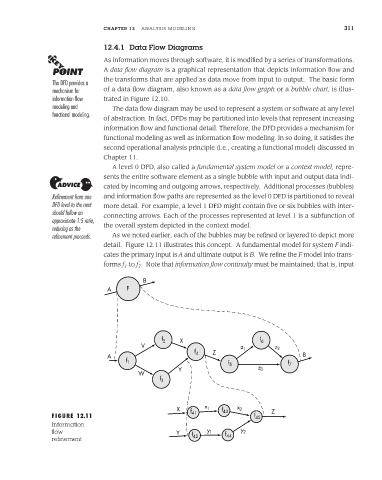
                              detail.  Figure 12.11 illustrates this concept.  A fundamental model for system F indi-
                              cates the primary input is A and ultimate output is B.  We refine the F model into trans-
                              forms f to f .  Note that information flow continuity must be maintained; that is, input
                                    1
                                       7
                                         B
                               A    F


                                              f 2  X                     f 6
                                        V                           z 1      z 2
                                                       f 4  Z
                               A                                                     B
                                    f 1
                                                                f 5              f 7
                                                   Y                     z 3
                                       W
                                             f 3

                                                  X   f 41  x 1  f 43  x 2  Z
               FIGURE 12.11                                             f 45
               Information
               flow                                Y        y 1      y 2
                                                      f 42      f 44
               refinement

