


Page 117 - Standard Handbook Of Petroleum & Natural Gas Engineering
P. 117
102    Mathematics

                   (text  continued from  page  97)
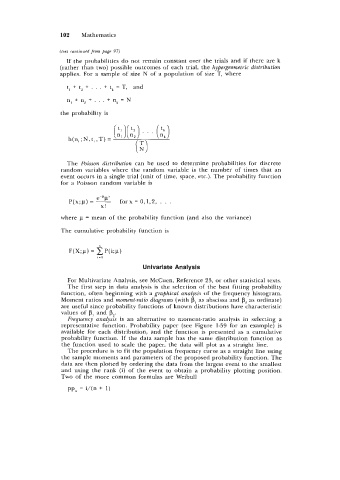
                     If  the probabilities do not remain constant over  the trials  and if  there are k
                   (rather than  two) possible outcomes of  each trial,  the hypergeometric  distribution
                   applies.  For  a  sample  of  size N  of  a population  of  size T, where

                     t, + t,  +  . . . +  t,  = T,  and
                     n, +  n2 + . . . + nt  = N

                   the probability  is


                     The Poisson  distribution  can  be  used  to  determine  probabilities for  discrete
                   random  variables  where  the  random  variable  is  the  number  of  times  that  an
                   event occurs  in a single trial  (unit of  time, space, etc.). The probability  function
                   for  a  Poisson  random variable  is


                   where p = mean  of  the probability  function  (and also  the variance)
                    The cumulative  probability  function  is


                                            Univariate Analysis
                      For Multivariate Analysis, see McCuen, Reference 23, or other statistical texts.
                      The first  step in  data analysis  is  the  selection  of  the best  fitting probability
                    function, often beginning with  a graphical  analysis  of  the frequency histogram.
                    Moment ratios and moment-ratio diagrams  (with 0, as abscissa and p,  as ordinate)
                    are useful  since probability  functions of known  distributions have characteristic
                    values  of  p,  and p,.
                      Frequency  analyszs  is  an  alternative  to  moment-ratio analysis  in  selecting  a
                    representative function. Probability  paper  (see Figure  1-59 for  an  example) is
                    available  for  each  distribution, and  the  function  is  presented  as  a  cumulative
                    probability  function.  If  the  data sample  has  the  same  distribution  function  as
                    the function used  to  scale  the paper, the data will  plot  as  a  straight line.
                      The procedure is  to fit the population frequency curve as a straight line using
                    the sample moments and parameters of  the proposed probability  function. The
                    data are then plotted by  ordering the data from the largest  event to the smallest
                    and  using  the  rank  (i)  of  the  event  to  obtain  a  probability  plotting  position.
                    Two of  the more  common formulas are Weibull
                      pp,  = i/(n  +  1)

