


Page 120 - Standard Handbook Of Petroleum & Natural Gas Engineering
P. 120
Applied  Statistics   105

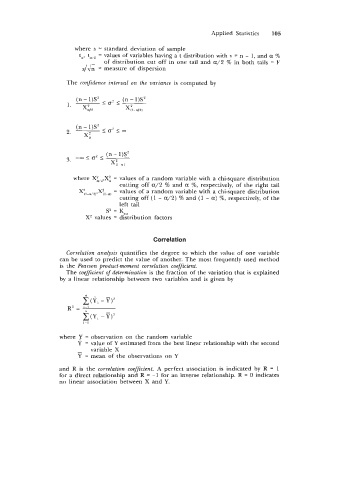
                        where  s  = standard deviation of  sample
                         ta,  t,,?  = values of variables having a t distribution with v  = n - 1, and a %
                                 of  distribution cut off  in  one tail  and a/2  %  in  both  tails  = F
                          s/&   = measure  of  dispersion

                     The confidence  interval  on  the  variance  is  computed by


                                    = values  of a random variable with  a chi-square distribution
                                     cutting off  a/2 %  and a %,  respectively, of  the right  tail
                                    = values  of a random variable with a chi-square distribution
                                     cutting off (1 - a/2) % and (1 - a) %,  respectively, of  the
                                     left  tail
                                 S2 = KCu
                           X2 values  = distribution  factors


                                                Correlation
                     Correlation  analysis  quantifies the degree  to which  the value  of  one variable
                   can be used to  predict  the value of  another. The most frequently  used  method
                   is  the Pearson  product-moment  correlation coefficient.
                     The coefficient  of  determination  is the fraction of  the variation  that is  explained
                   by  a linear  relationship between  two  variables and is  given by


                   where  Y  = observation on the  random variable
                         Y  = value of Y estimated from the best linear relationship with the second
                             variable  X
                         y  = mean  of  the  observations on Y
                   and  R  is  the  correlation  coefficient.  A  perfect  association  is  indicated by  R =  1
                   for a direct relationship and R  = -1  for an inverse relationship. R  = 0 indicates
                   no linear  association between  X  and Y.

