


Page 153 - Standard Handbook Of Petroleum & Natural Gas Engineering
P. 153
138   General Engineering and Science

                     produced by a couple is calculated by  multiplying the magnitude of one of the two
                     forces times the perpendicular distance between them. Moment is a vector quantity,
                     and its sense of direction is considered to be outwardly perpendicular to the plane of
                     counterclockwise rotation of the couple. The moment of a single force about some
                     point A is the magnitude of the force times the perpendicular distance between A
                     and the line of action of the force.
                       Velocity. A measure of the instantaneous rate of change of position in space with
                     respect to time. Velocity is a vector quantity.
                       Acceleration. A measure of the instantaneous rate of change in velocity with respect
                     to time. Acceleration is a vector quantity.
                       Gravitational acceleration. Every body falling in a vacuum at a given position above
                     and near  the  surface  of  the earth will  have the same acceleration,  g.  While  this
                     acceleration varies slightly over the earth’s surface due to local variations in its shape
                     and density, it is sufficiently accurate for most engineering calculations to assume
                     that g = 32.2 ft/s2 or 9.81 m/sp at the surface of the earth.
                       Weight. A measure of the force exerted on a body of mass M by the gravitational
                     attraction of the earth. The magnitude of this force is
                       W=Mg
                     where W is the weight of the body. Strictly speaking, weight is a vector quantity since
                     it is a force acting in the direction of the gravitational acceleration.

                     General Laws

                       The foregoing defined quantities interact according to the following fundamental
                     laws, which are based upon empirical evidence.
                       Conservation of  mass. The mass of a system of particles remains unchanged during
                     the course of ordinary physical events.
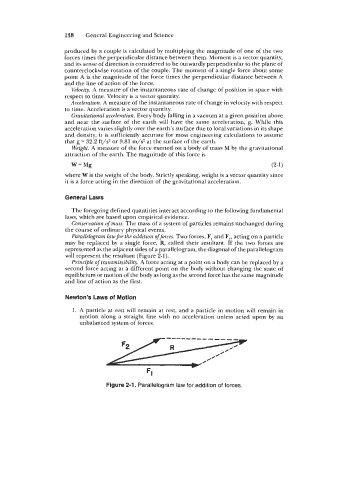
                       Parallelogram law for the addition of  forces. Two forces, F, and F,, acting on a particle
                     may  be replaced  by  a single force, R, called  their  resultant. If  the two forces are
                     represented as the adjacent sides of a parallelogram, the diagonal of the parallelogram
                     will represent the resultant (Figure 2-1).
                       Principle of  transmissibility.  A force acting at a point on a body can be replaced by a
                     second force acting at a different point on the body without changing the state of
                     equilibrium or motion of the body as long as the second force has the same magnitude
                     and line of action as the first.

                     Newton’s Laws of Motion

                       1. A particle at rest will  remain at rest, and a particle in motion will remain in
                         motion along a  straight line  with  no acceleration  unless  acted  upon  by  an
                         unbalanced system of forces.


                                              FI
                                  Figure 2-1. Parallelogram law for addition of forces.

