


Page 155 - Standard Handbook Of Petroleum & Natural Gas Engineering
P. 155
140   General Engineering and Science

                     components along the coordinate axes. For the particle to be in equilibrium, the sum
                     of the force components along each of the axes must be zero. This yields an algebraic
                     equation to be solved for the forces in each coordinate direction.
                     Example 2-1
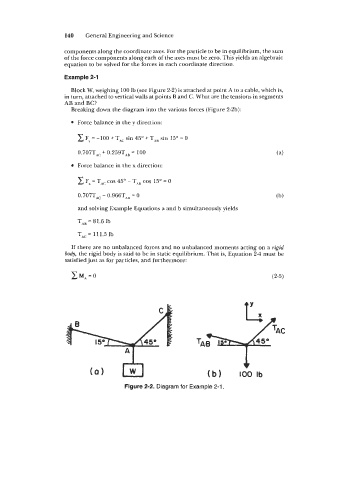
                       Block W, weighing 100 Ib (see Figure 2-2) is attached at point A to a cable, which is,
                     in turn, attached to vertical walls at points B and C. What are the tensions in segments
                     AB and BC?
                       Breaking down the diagram into the various forces (Figure 2-2b):

                         Force balance in the y direction:

                           F,  = -100 + T,  sin 45" + TAB sin 15" = 0
                         0.707T,  + 0.259TA, = 100

                         Force balance in the x direction:

                           F,  = T,  cos 45" - TAB cos 15" = 0

                         0.707TA, - 0.966TA, = 0
                         and solving Example Equations a and b simultaneously yields

                         TAB 81.6 lb
                            =
                         T,,   = 111.5 lb
                       If  there are no unbalanced forces and no unbalanced  moments acting on a rigid
                     body,  the rigid body is said to be in static equilibrium. That is, Equation 2-4 must be
                     satisfied just as for particles, and furthermore:

                                                             TAB y


                                                                            L


                                                                 (b)      100  Ib

                                       Figure 2-2. Diagram for Example 2-1.

