


Page 250 - Standard Handbook Of Petroleum & Natural Gas Engineering
P. 250
Thermodynamics    223

                                     Summary of Thermodynamic Equations

                       The thermodynamic relations formulated earlier for a pure substance are summarized
                     in Table  2-19 with unit mass of fluid as the basis. Several additional important relationships
                     can be derived from them and these are shown in the third column of Table 2-19.
                       By  mathematical  manipulation,  numerous additional  relationships can  be
                     derived from those given in Table 2-19. Of particular significance are expressions
                     that relate enthalpy H  and internal energy U  to  the measurable variables, P,  V,
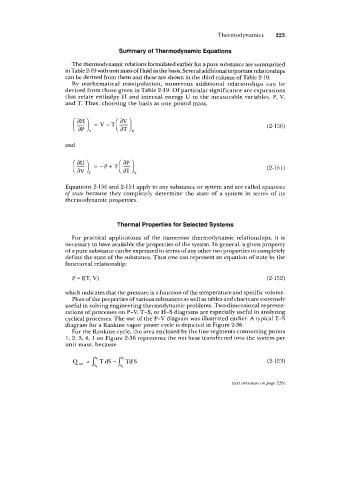
                     and T. Thus, choosing the basis as one pound mass,


                                                                                  (2-150)


                     and
                       (s)T               V                                       (2-151)

                               -P+.(%)
                              =

                     Equations 2-150 and 2-151 apply to any substance or system and are called equations
                     of  state because  they  completely  determine the state  of  a  system in  terms  of  its
                     thermodynamic properties.


                                     Thermal Properties for Selected Systems
                       For  practical  applications of  the  numerous  thermodynamic  relationships,  it  is
                     necessary to have available the properties of the system. In general, a given property
                     of a pure substance can be expressed in terms of any other two properties to completely
                     define the state of the substance. Thus one can represent an equation of state by the
                     functional relationship:

                       P = f(T, V)                                                (2-152)

                     which indicates that the pressure is a function of the temperature and specific volume.
                       Plots of the properties of various substances as well as tables and charts are extremely
                     useful in solving engineering thermodynamic problems. Two-dimensional represen-
                     tations of processes on P-V,  T-S, or H-S  diagrams are especially useful in analyzing
                     cyclical processes. The use of the P-V  diagram was illustrated earlier. A typical T-S
                     diagram for a Kankine vapor power cycle is depicted in Figure 2-36.
                       For the Rankine cycle, the area enclosed by the line segments connecting points
                     1, 2, 3, 4, 1 on Figure 2-36 represents the net heat transferred into the system per
                     unit mass, because

                              s,
                       Q,,, = js4 dS - I" S                                       (2-158)
                               T
                                       Td
                                      s>
                                                                        (lex1 continues on page 226)

