


Page 335 - Standard Handbook Petroleum Natural Gas Engineering VOLUME2
P. 335
302   Reservoir Engineering


                                             Well Test Analyses

                      In-situ oil saturations can be estimated by combining relative permeability data
                    determined in the laboratory with field well  test data such as:
                      Production data
                      Single well transient tests in producing wells
                        Pressure buildup
                        Pressure drawdown
                        Multiplerate  testing
                      Multiple-well transient tests
                        Interference tests
                        Pulse tests

                      Details of the methods for developing the well test data can be found in the
                    literature [ M,66,228], and were  summarized earlier. If  sufficient, good quality
                    relative permeability  data  are  available from  laboratory tests  that  simulate
                    downhole conditions, the techniques of  correlating well test analyses can give
                    some indication  of  the  reservoir  oil saturation.  For  these  techniques to  be
                    applicable, numerous  assumptions are  made:  the  reservoir  interval is  homo-
                    geneous, horizontal, and isotropic with a small and constant compressibility; fluid
                    properties and saturations are uniform in the formation; relative permeabilities
                    are constant throughout the test area: there are no oil-water or gas-oil contacts;
                    and the tested wells  are not affected by other wells  outside the test area [319].
                    The following discussion applies to waterflooded reservoirs with  no free gas
                    saturation, but could be extended to more complex systems.
                    Production Data

                      When the producing oil and water flow rates, formation volume factors, and
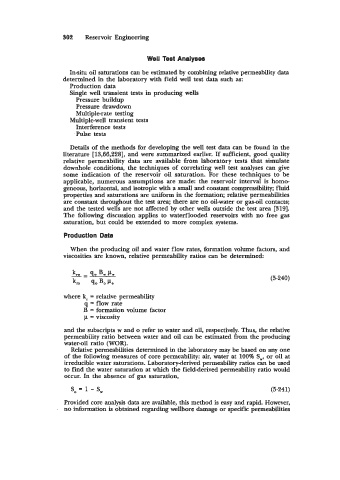
                    viscosities are known, relative permeability ratios can be determined


                                                                                  (5-240)

                    where k,  = relative permeability
                          q = flow rate
                          B = formation volume factor
                          p = viscosity

                    and the subscripts w and o refer to water and oil, respectively. Thus, the relative
                    permeability ratio between water and oil can be estimated from the producing
                    water-oil ratio (WOR).
                      Relative permeabilities determined in the laboratory may be based on any one
                    of the following measures of core permeability: air, water at 100% S, or oil at
                    irreducible water saturations. Laboratory-derived permeability ratios can be used
                    to find the water saturation at which the field-derived permeability ratio would
                    occur. In the absence of  gas saturation,

                      so = 1 - S"                                                 (5-241)
                    Provided core analysis data are available, this method is easy and rapid. However,
                    no information is obtained regarding wellbore damage or specific permeabilities

