


Page 244 - Statistics II for Dummies
P. 244
228        Part IV: Building Strong Connections with Chi-Square Tests


                                The sum of all the joint probabilities for any two-way table should be 1.00,
                                unless you have a little round-off error, which makes it very close to 1.00 but
                                not exactly. The sum is 1.00 because everyone in the group is classified some-
                                where with respect to both variables. It’s like dividing the entire group into
                                four parts and showing which proportion falls into each part.


                                Conditional probabilities

                                A conditional probability is what you use to compare subgroups in the
                                sample. In other words, if you want to break down the table further, you turn
                                to a conditional probability. Each row has a conditional probability for each
                                cell within the row, and each column has a conditional probability for each
                                cell within that column.

                                Note: Because conditional probability is one of the sticking points for a lot of
                                students, I spend extra time on it. My goal with this section is for you to have
                                a good understanding of what a conditional probability really means and how
                                you can use it in the real world (something many statistics textbooks neglect
                                to mention, I have to say).

                                Figuring conditional probabilities
                                To find a conditional probability, you first look at a single row or column of
                                the table that represents the known characteristic about the individuals. The
                                marginal total for that row (column) now represents your new grand total,
                                because this group becomes your entire universe when you examine it.
                                Then take the cell counts from that row (column) and divide the sum by the
                                marginal total for that row (column).

                                Consider the cellphone example in Table 13-3. Suppose you want to look at
                                just the males who took the survey. The total number of males is 508. You can
                                break down this group into two subgroups by using conditional probability:
                                You can find the probability of using cellphones for personal calls (males
                                only) and the probability of not using cellphones for personal calls (males
                                only). Similarly, you can break down the females into those females who use
                                cellphones for personal calls and those females who don’t.

                                In the cellphone example, you have the following conditional probabilities
                                when you break down the table by gender:

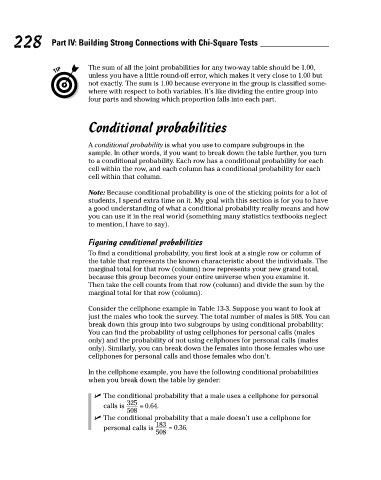
                                  ✓ The conditional probability that a male uses a cellphone for personal
                                     calls is      .
                                  ✓ The conditional probability that a male doesn’t use a cellphone for
                                     personal calls is     .


          20_466469-ch13.indd   228                                                                   7/24/09   9:47:57 AM

