


Page 273 - Statistics II for Dummies
P. 273
Chapter 14: Being Independent Enough for the Chi-Square Test  257


                      Comparing Two Tests for Comparing

                      Two Proportions


                                You can use the Chi-square test to check whether two population propor-
                                tions are equal. For example, is the proportion of female cellphone users the
                                same as the proportion of male cellphone users?

                                You may be thinking, “But wait a minute, don’t statisticians already have a
                                test for two proportions? I seem to remember it from my Stats I course . . .
                                I’m thinking . . . yeah, it’s the Z-test for two proportions. What’s that test got
                                to do with a Chi-square test?” In this section, you get an answer to that ques-
                                tion and practice using both methods to investigate a possible gender gap in
                                cellphone use.


                                Getting reacquainted with the Z-test
                                for two population proportions


                                The way that most people figure out how to test the equality of two popula-
                                tion proportions is to use a Z-test for two population proportions. With this
                                test, you collect a random sample from each of the two populations, find and
                                subtract their two sample proportions, and divide by their pooled standard
                                error (see your Stats I textbook for details on this particular test).
                                This test is possible to do as long as the sample sizes from the two popula-
                                tions are large — at least five successes and five failures in each sample.

                                The null hypothesis for the Z-test for two population proportions is
                                Ho: p  = p , where p  is the proportion of the first population that falls into the
                                     1  2        1
                                category of interest, and p  is the proportion of the second population that
                                                       2
                                falls into the category of interest. And as always, the alternative hypothesis is
                                one of the following choices, Ha: Not equal to, greater than, or less than.
                                Suppose you want to compare the proportion of male versus female cell-
                                phone users, where p  is the proportion of males who own a cellphone, and
                                                   1
                                p  is the proportion of all females who own a cellphone. You collect data, find
                                 2
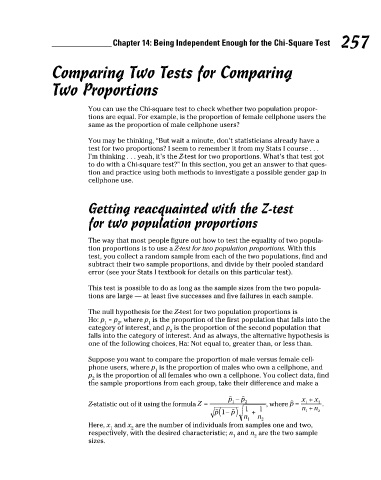
                                the sample proportions from each group, take their difference and make a

                                Z-statistic out of it using the formula           , where        .

                                Here, x  and x  are the number of individuals from samples one and two,
                                      1     2
                                respectively, with the desired characteristic; n  and n  are the two sample
                                                                        1     2
                                sizes.


          21_466469-ch14.indd   257                                                                   7/24/09   9:51:31 AM

