


Page 274 - Statistics II for Dummies
P. 274
258        Part IV: Building Strong Connections with Chi-Square Tests


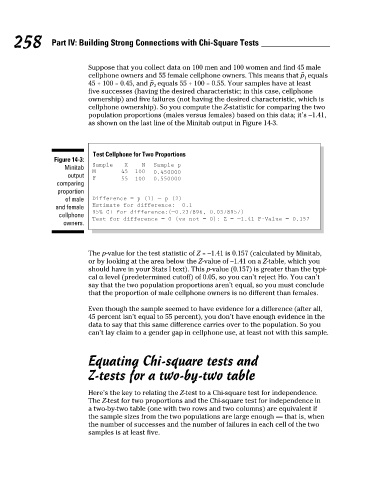
                                Suppose that you collect data on 100 men and 100 women and find 45 male
                                cellphone owners and 55 female cellphone owners. This means that   equals
                                45 ÷ 100 = 0.45, and   equals 55 ÷ 100 = 0.55. Your samples have at least
                                five successes (having the desired characteristic; in this case, cellphone
                                ownership) and five failures (not having the desired characteristic, which is
                                cellphone ownership). So you compute the Z-statistic for comparing the two
                                population proportions (males versus females) based on this data; it’s –1.41,
                                as shown on the last line of the Minitab output in Figure 14-3.


                                 Test Cellphone for Two Proportions
                       Figure 14-3:
                                 Sample   X    N  Sample p
                          Minitab
                                 M       45  100  0.450000
                          output
                                 F       55  100  0.550000
                       comparing
                        proportion
                          of male   Difference = p (1) — p (2)
                       and female   Estimate for difference: —0.1
                                 95% CI for difference:(—0.237896, 0.0378957)
                        cellphone
                                 Test for difference = 0 (vs not = 0): Z = —1.41 P-Value = 0.157
                         owners.

                                The p-value for the test statistic of Z = –1.41 is 0.157 (calculated by Minitab,
                                or by looking at the area below the Z-value of –1.41 on a Z-table, which you
                                should have in your Stats I text). This p-value (0.157) is greater than the typi-
                                cal α level (predetermined cutoff) of 0.05, so you can’t reject Ho. You can’t
                                say that the two population proportions aren’t equal, so you must conclude
                                that the proportion of male cellphone owners is no different than females.

                                Even though the sample seemed to have evidence for a difference (after all,
                                45 percent isn’t equal to 55 percent), you don’t have enough evidence in the
                                data to say that this same difference carries over to the population. So you
                                can’t lay claim to a gender gap in cellphone use, at least not with this sample.


                                Equating Chi-square tests and

                                Z-tests for a two-by-two table


                                Here’s the key to relating the Z-test to a Chi-square test for independence.
                                The Z-test for two proportions and the Chi-square test for independence in
                                a two-by-two table (one with two rows and two columns) are equivalent if
                                the sample sizes from the two populations are large enough — that is, when
                                the number of successes and the number of failures in each cell of the two
                                samples is at least five.


          21_466469-ch14.indd   258                                                                   7/24/09   9:51:31 AM

