


Page 354 - Statistics for Dummies
P. 354
338
                                         Part VI: The Part of Tens
                                                    To make this happen, many of my students find help in making what I call an
                                                    if-then-how chart. An if-then-how chart maps out the types of problems you are
                                                    likely to run into, strategies to solve them, and examples for quick reference. The
                                                    basic idea of the if-then-how chart is to say “If the problem asks for X, then I solve
                                                    it by doing Y, and here’s how.” An if-then-how chart contains three columns:
                                                     ✓ If: In the if column, write down a succinct description of what you are
                                                        asked to find or do. For example, if the problem asks you to test a claim
                                                        about the population mean (see Chapter 14 for more about claims),
                                                        write “Test a claim — population mean.” If you are asked to give your
                                                        best estimate of the population mean (Chapter 13 has the scoop on esti-
                                                        mates), write “Estimate population mean.”

                                                        Problems are worded in different ways, because that’s how the real
                                                        world works. Pay attention to different wordings that in essence boil
                                                        down to the same problem, and add them to the appropriate place in the
                                                        if column where the actual problem is already listed. For example, one
                                                        problem may ask you to estimate the population mean; another problem
                                                        may say, “Give a range of likely values for the population mean.” These
                                                        questions ask for the same thing, so include both in your if column.
                                                     ✓ Then: In your then column you write the exact statistical procedure, for-
                                                        mula, or technique you need to solve that type of problem using the statisti-
                                                        cal lingo. For example, when your if column says “Test a claim — population
                                                        mean,” your then column should say “Hypothesis test for μ.” When your if
                                                        statement reads “Estimate population mean” your then column should read
                                                        “Confidence interval for μ.”
                                                        To match strategies to situations, look carefully at how the examples in
                                                        your lecture notes and your book were done and use them as your guide.
                                                     ✓ How: In the how column, write an example, a formula, and/or a quick
                                                        note to yourself that will spark your mind and send you off running in
                                                        the right direction. Write whatever you need to feel comfortable (no
                                                        one’s going to see it but you, so make it your way!). For example, sup-
                                                        pose your if column says “Estimate the population mean,” and your
                                                        then column says “Confidence interval — population mean.” In the how
                                                        column, you can write the formula.
                                                    Although I just took a lot of time and talking to walk you through it, making
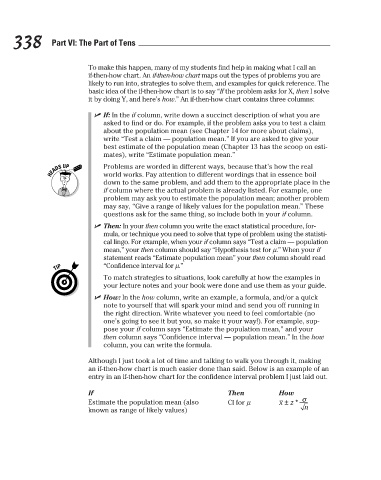
                                                    an if-then-how chart is much easier done than said. Below is an example of an
                                                    entry in an if-then-how chart for the confidence interval problem I just laid out.
                                                    If                                     Then          How
                                                    Estimate the population mean (also     CI for μ
                                                    known as range of likely values)


                                                                                                                           3/25/11   8:12 PM
                             30_9780470911082-ch21.indd   338                                                              3/25/11   8:12 PM
                             30_9780470911082-ch21.indd   338

