


Page 352 - Statistics for Dummies
P. 352
336
                                         Part VI: The Part of Tens
                                                    Being critical of yourself is hard, and finding out you didn’t know something

                                                    you thought you knew is a little scary. But if you put yourself out there and
                                                    find your mistakes before they cost you points, you’ll zoom in on your weak-
                                                    nesses, turn them into strengths, boost your knowledge, and get a higher
                                                    exam score.
                                         Make Friends with Formulas
                                                    Many students are not comfortable with formulas (unless you are a math
                                                    nerd, in which case formulas make you shout for joy). That unease is
                                                    understandable — I used to be intimidated by them too (formulas, that is —
                                                    not math nerds). The trouble is, you really can’t survive too long without
                                                    eventually using a formula in a statistics class, so becoming comfortable with
                                                    them right from the start is important. A formula tells you much more than
                                                    how to calculate something. It shows the thinking process behind the calcula-
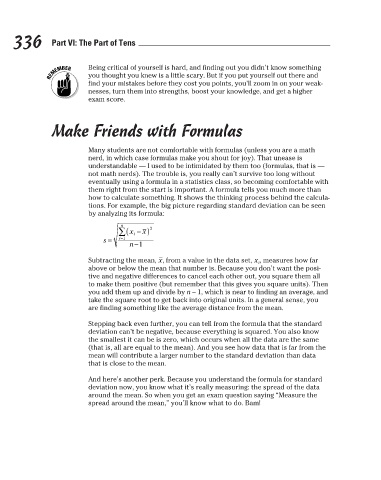
                                                    tions. For example, the big picture regarding standard deviation can be seen
                                                    by analyzing its formula:
                                                    Subtracting the mean,  , from a value in the data set,  , measures how far
                                                    above or below the mean that number is. Because you don’t want the posi-
                                                    tive and negative differences to cancel each other out, you square them all
                                                    to make them positive (but remember that this gives you square units). Then
                                                    you add them up and divide by n – 1, which is near to finding an average, and
                                                    take the square root to get back into original units. In a general sense, you
                                                    are finding something like the average distance from the mean.
                                                    Stepping back even further, you can tell from the formula that the standard
                                                    deviation can’t be negative, because everything is squared. You also know
                                                    the smallest it can be is zero, which occurs when all the data are the same
                                                    (that is, all are equal to the mean). And you see how data that is far from the
                                                    mean will contribute a larger number to the standard deviation than data
                                                    that is close to the mean.
                                                    And here’s another perk. Because you understand the formula for standard
                                                    deviation now, you know what it’s really measuring: the spread of the data
                                                    around the mean. So when you get an exam question saying “Measure the
                                                    spread around the mean,” you’ll know what to do. Bam!


                                                                                                                           3/25/11   8:12 PM
                             30_9780470911082-ch21.indd   336                                                              3/25/11   8:12 PM
                             30_9780470911082-ch21.indd   336

