


Page 341 - Structural Steel Designers Handbook AISC, AASHTO, AISI, ASTM, and ASCE-07 Design Standards
P. 341
Brockenbrough_Ch07.qxd  9/29/05  5:17 PM  Page 7.25


                                                     FLOOR AND ROOF SYSTEMS


                                                                                 FLOOR AND ROOF SYSTEMS  7.25

                                                       ROOF FRAMING

                                  The systems used for floor framing (Arts. 7.8 to 7.14) can also be used for roof framing. Other roof
                                  framing systems are described below.

                      7.19 PLATE GIRDERS

                                  For long spans or heavy loadings that exceed the capacity of standard rolled shapes, plate girders can
                                  be used. Plate girders are composed of individual steel plates that can vary in width, thickness, and
                                  grade of steel along their length to optimize the cross section. However, it is important to recognize
                                  that a minimum weight design is not always the most cost effective design. For example, it is often
                                  more economical to use a thicker web plate, rather than a thinner one with multiple transverse stiff-
                                  eners, because of the reduced fabrication costs. Also, the material savings obtained from splicing
                                  flange plates to change thickness may be offset by the cost of the welded splice. (See Art. 10.16.)


                      7.20 SPACE FRAMES

                                  Space frames represent one of the more efficient uses of structural materials. Space frames are three-
                                  dimensional lattice-type structures that span in more than one direction. It is common practice to apply
                                  the “space frame” designation to structures that would more accurately be categorized as “space trusses,”
                                  that is, assemblies of members pin-connected at the joints, or nodes.
                                    In addition to providing great rigidity and inherent redundancy, space frames can span large areas
                                  economically, providing exceptional flexibility of usage within the structure by eliminating interior
                                  columns. Space frames possess a versatility of shape and form. They can utilize a standard module
                                  to generate flat grids, barrel vaults, domes, and free-form shapes.
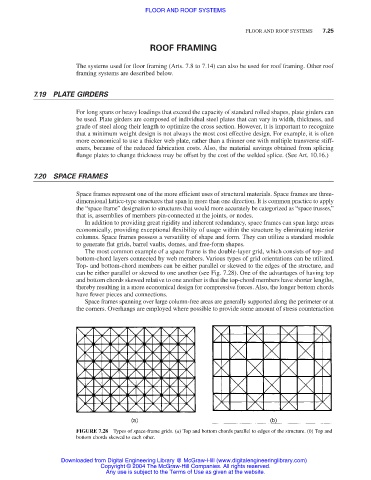
                                    The most common example of a space frame is the double-layer grid, which consists of top- and
                                  bottom-chord layers connected by web members. Various types of grid orientations can be utilized.
                                  Top- and bottom-chord members can be either parallel or skewed to the edges of the structure, and
                                  can be either parallel or skewed to one another (see Fig. 7.28). One of the advantages of having top
                                  and bottom chords skewed relative to one another is that the top-chord members have shorter lengths,
                                  thereby resulting in a more economical design for compressive forces. Also, the longer bottom chords
                                  have fewer pieces and connections.
                                    Space frames spanning over large column-free areas are generally supported along the perimeter or at
                                  the corners. Overhangs are employed where possible to provide some amount of stress counteraction


                                  FIGURE 7.28  Types of space-frame grids. (a) Top and bottom chords parallel to edges of the structure. (b) Top and
                                  bottom chords skewed to each other.


                              Downloaded from Digital Engineering Library @ McGraw-Hill (www.digitalengineeringlibrary.com)
                                         Copyright © 2004 The McGraw-Hill Companies. All rights reserved.
                                          Any use is subject to the Terms of Use as given at the website.

