


Page 342 - Structural Steel Designers Handbook AISC, AASHTO, AISI, ASTM, and ASCE-07 Design Standards
P. 342
Brockenbrough_Ch07.qxd  9/29/05  5:17 PM  Page 7.26


                                                  FLOOR AND ROOF SYSTEMS


                   7.26  CHAPTER SEVEN

                               to relieve the interior chord forces and to provide a greater number of “active” diagonal web members
                               to distribute the reactions at supports into the space frame. In cases where the reactions are very
                               large, space-frame members near the supports are sometimes extended beneath the bottom chord, in
                               the form of inverted pyramids, to the top of the columns. This effectively produces a column capital,
                               which facilitates distribution of forces into the space frame.
                                 The depth of a space frame is generally 4–8% of its span. To effectively utilize the two-way spanning
                               capability of a space frame, the aspect (length-to-width) ratio should generally not exceed 1.5:1.0.
                               For a 1.5:1.0 ratio, about 70% of the gravity loads are carried by the short span.
                                 Types of members used for space frames may be structural steel hot-rolled shapes, or round or rec-
                               tangular tubes, or cold-formed steel sections. Many space frames are capable of utilizing two or more
                               different member types.
                                 For some space-frame roof structures, the top chords also act as purlins to directly support the
                               roofing system. In these cases, the top chords must be designed for a combination of axial and bending
                               stresses. For other roof structures, a separate subframing system is utilized for the roofing system,
                               and an interface connection to the space frame is provided at the top chord nodes. In these cases, the
                               roofing system does not transmit bending stresses to the top chord members.
                                 Regardless of the type of space frame, the essence of any such system is its node. Most space
                               frame systems have concentric nodes; that is, the centroidal axes of all members framing into a node
                               project to a common working point at the center of the node. Some systems, however, have eccentric
                               joints. For these, local bending of the members must be considered in addition to the basic joint and
                               member stresses.
                                 Most space frames are assembled either in-place on a piece-by-piece basis, or in portions on the
                               ground and then lifted into place. In some cases, where construction sequencing permits, the entire
                               space frame can be preassembled on the ground and then lifted into place.


                   7.21 ARCHED ROOFS

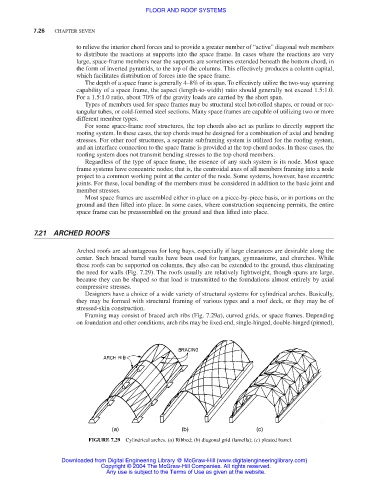
                               Arched roofs are advantageous for long bays, especially if large clearances are desirable along the
                               center. Such braced barrel vaults have been used for hangars, gymnasiums, and churches. While
                               these roofs can be supported on columns, they also can be extended to the ground, thus eliminating
                               the need for walls (Fig. 7.29). The roofs usually are relatively lightweight, though spans are large,
                               because they can be shaped so that load is transmitted to the foundations almost entirely by axial
                               compressive stresses.
                                 Designers have a choice of a wide variety of structural systems for cylindrical arches. Basically,
                               they may be formed with structural framing of various types and a roof deck, or they may be of
                               stressed-skin construction.
                                 Framing may consist of braced arch ribs (Fig. 7.29a), curved grids, or space frames. Depending
                               on foundation and other conditions, arch ribs may be fixed-end, single-hinged, double-hinged (pinned),


                                  FIGURE 7.29  Cylindrical arches. (a) Ribbed; (b) diagonal grid (lamella); (c) pleated barrel.

                           Downloaded from Digital Engineering Library @ McGraw-Hill (www.digitalengineeringlibrary.com)
                                      Copyright © 2004 The McGraw-Hill Companies. All rights reserved.
                                       Any use is subject to the Terms of Use as given at the website.

