


Page 343 - Structural Steel Designers Handbook AISC, AASHTO, AISI, ASTM, and ASCE-07 Design Standards
P. 343
Brockenbrough_Ch07.qxd  9/29/05  5:17 PM  Page 7.27


                                                     FLOOR AND ROOF SYSTEMS


                                                                                 FLOOR AND ROOF SYSTEMS  7.27

                                  or triple-hinged (statically determinate). Much lighter members can be employed for a diagonal grid, or
                                  lamella, system (Fig. 7.29b), but many more members must be handled.
                                    With stressed-skin construction, the roof deck acts integrally with the framing in carrying the load.
                                    As in folded-plate construction, the stiffness can be increased by pleating or undulating the
                                  surface (Fig. 7.29c).
                                    Regardless of the type of structural system selected, provision must be made for resisting the arch
                                  thrust. If ground conditions permit, the thrust may be resisted entirely by the foundations. Otherwise,
                                  ties must be used. Arches supported above grade may be buttressed or tied.


                      7.22 DOME ROOFS


                                  Dome roofs are preferable to arches where the large column-free area to be covered is circular, elliptical,
                                  or approximately an equal-sided polygon. They often have been used for the roofs of exhibition
                                  buildings, arenas, planetariums, water reservoirs, and gas tanks. Also, the feasibility of covering large
                                  stadiums with domes has been demonstrated. Domes are relatively lightweight, despite long spans,
                                  because they can be shaped so that loads induce mainly axial stresses.
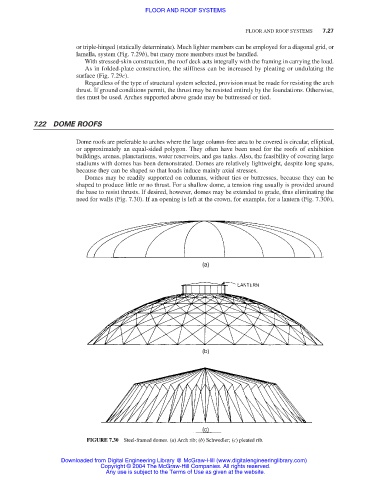
                                    Domes may be readily supported on columns, without ties or buttresses, because they can be
                                  shaped to produce little or no thrust. For a shallow dome, a tension ring usually is provided around
                                  the base to resist thrusts. If desired, however, domes may be extended to grade, thus eliminating the
                                  need for walls (Fig. 7.30). If an opening is left at the crown, for example, for a lantern (Fig. 7.30b),


                                     FIGURE 7.30  Steel-framed domes. (a) Arch rib; (b) Schwedler; (c) pleated rib.

                              Downloaded from Digital Engineering Library @ McGraw-Hill (www.digitalengineeringlibrary.com)
                                         Copyright © 2004 The McGraw-Hill Companies. All rights reserved.
                                          Any use is subject to the Terms of Use as given at the website.

