


Page 372 - Structural Steel Designers Handbook AISC, AASHTO, AISI, ASTM, and ASCE-07 Design Standards
P. 372
Brockenbrough_Ch08.qxd  9/29/05  5:21 PM  Page 8.26


                                                    LATERAL-FORCE DESIGN


                   8.26  CHAPTER EIGHT


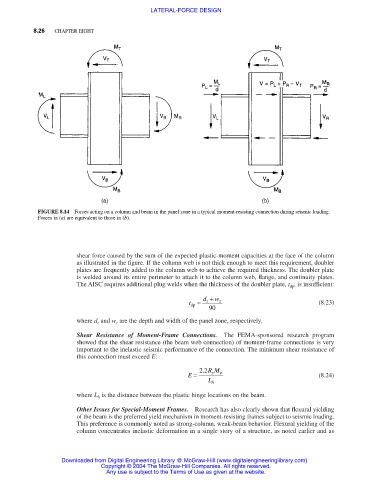
                    FIGURE 8.14 Forces acting on a column and beam in the panel zone in a typical moment-resisting connection during seismic loading.
                    Forces in (a) are equivalent to those in (b).


                               shear force caused by the sum of the expected plastic-moment capacities at the face of the column
                               as illustrated in the figure. If the column web is not thick enough to meet this requirement, doubler
                               plates are frequently added to the column web to achieve the required thickness. The doubler plate
                               is welded around its entire perimeter to attach it to the column web, flange, and continuity plates.
                               The AISC requires additional plug welds when the thickness of the doubler plate, t dp , is insufficient:

                                                                  d + w
                                                              t dp  =  z  z                        (8.23)
                                                                    90
                               where d z and w z are the depth and width of the panel zone, respectively.
                               Shear Resistance of Moment-Frame Connections.  The FEMA-sponsored research program
                               showed that the shear resistance (the beam web connection) of moment-frame connections is very
                               important to the inelastic seismic performance of the connection. The minimum shear resistance of
                               this connection must exceed E:

                                                                 22 RM
                                                                  .
                                                              E =    y  p                          (8.24)
                                                                    L h
                               where L h is the distance between the plastic hinge locations on the beam.
                               Other Issues for Special-Moment Frames.  Research has also clearly shown that flexural yielding
                               of the beam is the preferred yield mechanism in moment-resisting frames subject to seismic loading.
                               This preference is commonly noted as strong-column, weak-beam behavior. Flexural yielding of the
                               column concentrates inelastic deformation in a single story of a structure, as noted earlier and as


                           Downloaded from Digital Engineering Library @ McGraw-Hill (www.digitalengineeringlibrary.com)
                                      Copyright © 2004 The McGraw-Hill Companies. All rights reserved.
                                       Any use is subject to the Terms of Use as given at the website.

