


Page 368 - Structural Steel Designers Handbook AISC, AASHTO, AISI, ASTM, and ASCE-07 Design Standards
P. 368
Brockenbrough_Ch08.qxd  9/29/05  5:21 PM  Page 8.22


                                                    LATERAL-FORCE DESIGN


                   8.22  CHAPTER EIGHT

                               where r y is the radius of gyration about the weak axis of the member and F y is the specified mini-
                               mum yield stress, ksi, of the steel. The objective of this limit is to control lateral torsional buckling
                               during plastic deformation under cyclic loading. The lateral bracing adjacent to plastic hinges must
                               be applied to both the top and bottom flanges, and the lateral bracing must have adequate lateral
                               resistance to develop 6% of the nominal force in the beam flange at the expected plastic-moment
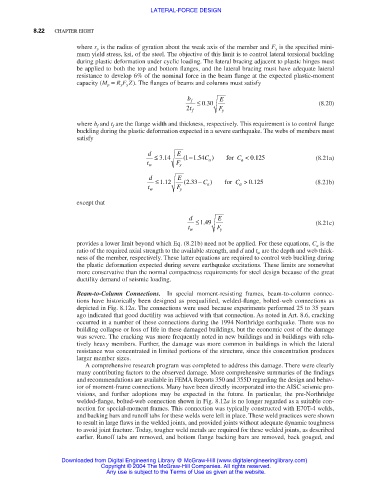
                               capacity (M p = R y F y Z). The flanges of beams and columns must satisfy

                                                              b f  ≤  030  E
                                                                   .
                                                               t 2  f  F y                         (8.20)
                               where b f and t f are the flange width and thickness, respectively. This requirement is to control flange
                               buckling during the plastic deformation expected in a severe earthquake. The webs of members must
                               satisfy

                                                   d       E
                                                     ≤ 314   1 (  −154 C )  for   C < 0.125       (8.21a)
                                                       .
                                                                .
                                                                             a
                                                                    a
                                                   t w     F y
                                                   d       E
                                                     ≤112    ( 233 −  C )  for   C > 0.125        (8.21b)
                                                               .
                                                       .
                                                                   a
                                                                             a
                                                   t w     F y
                               except that
                                                              d       E
                                                                ≤149                              (8.21c)
                                                                  .
                                                              t       F
                                                               w       y
                               provides a lower limit beyond which Eq. (8.21b) need not be applied. For these equations, C a is the
                               ratio of the required axial strength to the available strength, and d and t w are the depth and web thick-
                               ness of the member, respectively. These latter equations are required to control web buckling during
                               the plastic deformation expected during severe earthquake excitations. These limits are somewhat
                               more conservative than the normal compactness requirements for steel design because of the great
                               ductility demand of seismic loading.
                               Beam-to-Column Connections.  In special moment-resisting frames, beam-to-column connec-
                               tions have historically been designed as prequalified, welded-flange, bolted-web connections as
                               depicted in Fig. 8.12a. The connections were used because experiments performed 25 to 35 years
                               ago indicated that good ductility was achieved with that connection. As noted in Art. 8.6, cracking
                               occurred in a number of these connections during the 1994 Northridge earthquake. There was no
                               building collapse or loss of life in these damaged buildings, but the economic cost of the damage
                               was severe. The cracking was more frequently noted in new buildings and in buildings with rela-
                               tively heavy members. Further, the damage was more common in buildings in which the lateral
                               resistance was concentrated in limited portions of the structure, since this concentration produces
                               larger member sizes.
                                 A comprehensive research program was completed to address this damage. There were clearly
                               many contributing factors to the observed damage. More comprehensive summaries of the findings
                               and recommendations are available in FEMA Reports 350 and 355D regarding the design and behav-
                               ior of moment-frame connections. Many have been directly incorporated into the AISC seismic pro-
                               visions, and further adoptions may be expected in the future. In particular, the pre-Northridge
                               welded-flange, bolted-web connection shown in Fig. 8.12a is no longer regarded as a suitable con-
                               nection for special-moment frames. This connection was typically constructed with E70T-4 welds,
                               and backing bars and runoff tabs for these welds were left in place. These weld practices were shown
                               to result in large flaws in the welded joints, and provided joints without adequate dynamic toughness
                               to avoid joint fracture. Today, tougher weld metals are required for these welded joints, as described
                               earlier. Runoff tabs are removed, and bottom flange backing bars are removed, back gouged, and


                           Downloaded from Digital Engineering Library @ McGraw-Hill (www.digitalengineeringlibrary.com)
                                      Copyright © 2004 The McGraw-Hill Companies. All rights reserved.
                                       Any use is subject to the Terms of Use as given at the website.

