


Page 366 - Structural Steel Designers Handbook AISC, AASHTO, AISI, ASTM, and ASCE-07 Design Standards
P. 366
Brockenbrough_Ch08.qxd  9/29/05  5:21 PM  Page 8.20


                                                    LATERAL-FORCE DESIGN


                   8.20  CHAPTER EIGHT


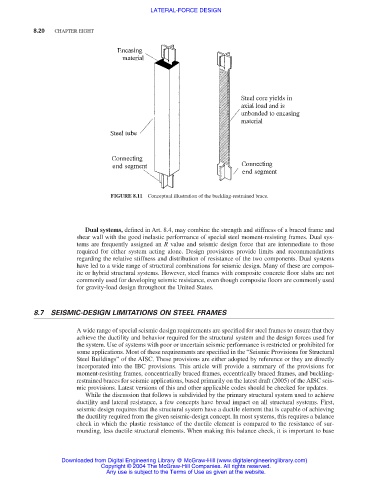
                                         FIGURE 8.11  Conceptual illustration of the buckling-restrained brace.


                                 Dual systems, defined in Art. 8.4, may combine the strength and stiffness of a braced frame and
                               shear wall with the good inelastic performance of special steel moment-resisting frames. Dual sys-
                               tems are frequently assigned an R value and seismic design force that are intermediate to those
                               required for either system acting alone. Design provisions provide limits and recommendations
                               regarding the relative stiffness and distribution of resistance of the two components. Dual systems
                               have led to a wide range of structural combinations for seismic design. Many of these are compos-
                               ite or hybrid structural systems. However, steel frames with composite concrete floor slabs are not
                               commonly used for developing seismic resistance, even though composite floors are commonly used
                               for gravity-load design throughout the United States.


                   8.7 SEISMIC-DESIGN LIMITATIONS ON STEEL FRAMES

                               A wide range of special seismic design requirements are specified for steel frames to ensure that they
                               achieve the ductility and behavior required for the structural system and the design forces used for
                               the system. Use of systems with poor or uncertain seismic performance is restricted or prohibited for
                               some applications. Most of these requirements are specified in the “Seismic Provisions for Structural
                               Steel Buildings” of the AISC. These provisions are either adopted by reference or they are directly
                               incorporated into the IBC provisions. This article will provide a summary of the provisions for
                               moment-resisting frames, concentrically braced frames, eccentrically braced frames, and buckling-
                               restrained braces for seismic applications, based primarily on the latest draft (2005) of the AISC seis-
                               mic provisions. Latest versions of this and other applicable codes should be checked for updates.
                                 While the discussion that follows is subdivided by the primary structural system used to achieve
                               ductility and lateral resistance, a few concepts have broad impact on all structural systems. First,
                               seismic design requires that the structural system have a ductile element that is capable of achieving
                               the ductility required from the given seismic-design concept. In most systems, this requires a balance
                               check in which the plastic resistance of the ductile element is compared to the resistance of sur-
                               rounding, less ductile structural elements. When making this balance check, it is important to base


                           Downloaded from Digital Engineering Library @ McGraw-Hill (www.digitalengineeringlibrary.com)
                                      Copyright © 2004 The McGraw-Hill Companies. All rights reserved.
                                       Any use is subject to the Terms of Use as given at the website.

