


Page 363 - Structural Steel Designers Handbook AISC, AASHTO, AISI, ASTM, and ASCE-07 Design Standards
P. 363
Brockenbrough_Ch08.qxd  9/29/05  5:21 PM  Page 8.17


                                                       LATERAL-FORCE DESIGN


                                                                                   LATERAL-FORCE DESIGN  8.17

                                             8
                                                                             Approx. 20% of resistance
                                                                             required to remain elastic
                                             6
                                             4

                                             2
                                          Time (s)  −2 0


                                            −4

                                            −6                                  Frame with approx. 40%
                                                                                of resistance required to
                                                                                remain elastic
                                            −8
                                                                      Elastic structure
                                           −10
                                              0                5                10               15
                                                               Relative displacement (in)
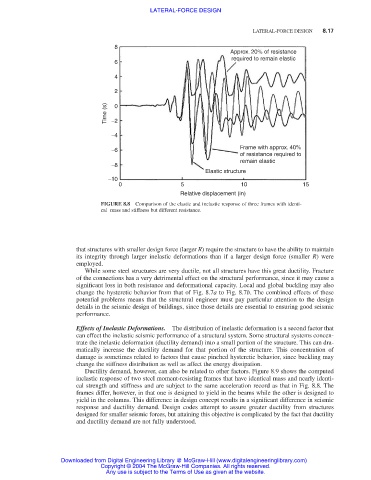
                                         FIGURE 8.8  Comparison of the elastic and inelastic response of three frames with identi-
                                         cal  mass and stiffness but different resistance.


                                  that structures with smaller design force (larger R) require the structure to have the ability to maintain
                                  its integrity through larger inelastic deformations than if a larger design force (smaller  R) were
                                  employed.
                                    While some steel structures are very ductile, not all structures have this great ductility. Fracture
                                  of the connections has a very detrimental effect on the structural performance, since it may cause a
                                  significant loss in both resistance and deformational capacity. Local and global buckling may also
                                  change the hysteretic behavior from that of Fig. 8.7a to Fig. 8.7b. The combined effects of these
                                  potential problems means that the structural engineer must pay particular attention to the design
                                  details in the seismic design of buildings, since those details are essential to ensuring good seismic
                                  performance.
                                  Effects of Inelastic Deformations.  The distribution of inelastic deformation is a second factor that
                                  can effect the inelastic seismic performance of a structural system. Some structural systems concen-
                                  trate the inelastic deformation (ductility demand) into a small portion of the structure. This can dra-
                                  matically increase the ductility demand for that portion of the structure.  This concentration of
                                  damage is sometimes related to factors that cause pinched hysteretic behavior, since buckling may
                                  change the stiffness distribution as well as affect the energy dissipation.
                                    Ductility demand, however, can also be related to other factors. Figure 8.9 shows the computed
                                  inelastic response of two steel moment-resisting frames that have identical mass and nearly identi-
                                  cal strength and stiffness and are subject to the same acceleration record as that in Fig. 8.8. The
                                  frames differ, however, in that one is designed to yield in the beams while the other is designed to
                                  yield in the columns. This difference in design concept results in a significant difference in seismic
                                  response and ductility demand. Design codes attempt to assure greater ductility from structures
                                  designed for smaller seismic forces, but attaining this objective is complicated by the fact that ductility
                                  and ductility demand are not fully understood.


                              Downloaded from Digital Engineering Library @ McGraw-Hill (www.digitalengineeringlibrary.com)
                                         Copyright © 2004 The McGraw-Hill Companies. All rights reserved.
                                          Any use is subject to the Terms of Use as given at the website.

