


Page 165 - Materials Chemistry, Second Edition
P. 165
Ch004-P373623.qxd  3/26/07  4:46 PM  Page 144
                     Sustainable Industrial Design and Waste Management
                144
                                         Project
                                 Submission of letter of intent     Appeal by project


                       Review by the Competent Administrative Authority (CAA)
                          to check content and project category (A, B, or C)


                        White (A)       Gray (B)        Black (C)
                       minor impact    some impact     major impact

                         Form A          Form B         Full EIA


                                Governmental Environmental
                                   Affairs Agency (GEAA)

                                                                  Rejection
                                       Scoped EIA    Permanent appeals committee
                       Acceptance
                                       is required   review appeal by project and
                                                     then a final decision is passed
                                                         back to the GEAA

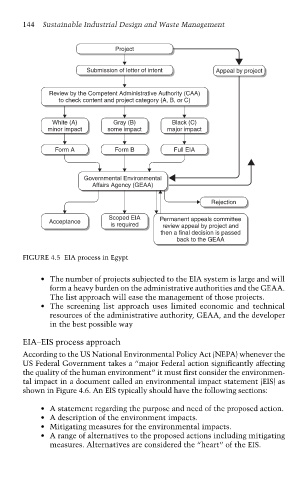
                FIGURE 4.5 EIA process in Egypt

                     • The number of projects subjected to the EIA system is large and will
                       form a heavy burden on the administrative authorities and the GEAA.
                       The list approach will ease the management of those projects.
                     • The screening list approach uses limited economic and technical
                       resources of the administrative authority, GEAA, and the developer
                       in the best possible way

                EIA–EIS process approach
                According to the US National Environmental Policy Act (NEPA) whenever the
                US Federal Government takes a “major Federal action significantly affecting
                the quality of the human environment” it must first consider the environmen-
                tal impact in a document called an environmental impact statement (EIS) as
                shown in Figure 4.6. An EIS typically should have the following sections:

                     • A statement regarding the purpose and need of the proposed action.
                     • A description of the environment impacts.
                     • Mitigating measures for the environmental impacts.
                     • A range of alternatives to the proposed actions including mitigating
                       measures. Alternatives are considered the “heart” of the EIS.

