


Page 400 - Sustainable On-Site CHP Systems Design, Construction, and Operations
P. 400
Governmental Facility—Mission Critical      373


             most rigorous performance requirement is for a gen-set power to be available for emer-
             gency egress lighting within 10-seconds and run for 90-minutes; a requirement that is
             sometimes met with a static reserve such as a battery. Other life safety infrastructure
             such as fire pumps, elevators, and fire alarm systems demand more from the prime
             mover. As long as life safety requirements are met, the NEC permits the same prime
             mover(s) to be used to supply backup power to other optional standby loads.
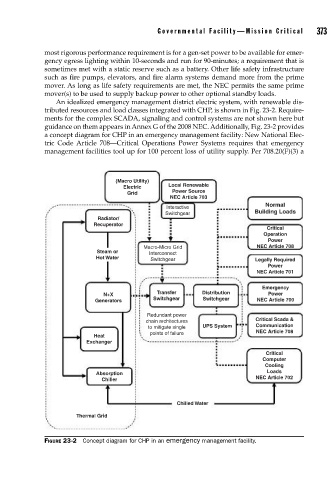
                An idealized emergency management district electric system, with renewable dis-
             tributed resources and load classes integrated with CHP, is shown in Fig. 23-2. Require-
             ments for the complex SCADA, signaling and control systems are not shown here but
             guidance on them appears in Annex G of the 2008 NEC. Additionally, Fig. 23-2 provides
             a concept diagram for CHP in an emergency management facility: New National Elec-
             tric Code  Article 708—Critical Operations Power Systems requires that emergency
             management facilities tool up for 100 percent loss of utility supply. Per 708.20(F)(3) a


                                 (Macro Utility)
                                                Local Renewable
                                   Electric
                                    Grid         Power Source
                                                NEC Article 703
                                                                           Normal
                                               Interactive
                                               Switchgear               Building Loads
                            Radiator/
                           Recuperator
                                                                           Critical
                                                                          Operation
                                                                            Power
                                         Macro-Micro Grid               NEC Article 708
                            Steam or      Interconnect
                            Hot Water      Switchgear                   Legally Required
                                                                            Power
                                                                        NEC Article 701
                                                                          Emergency
                                             Transfer    Distribution       Power
                              N+X
                           Generators       Switchgear   Switchgear      NEC Article 700
                                          Redundant power
                                                                        Critical Scada &
                                          chain architectures
                                          to mitigate single  UPS System  Communication
                                           points of failure            NEC Article 708
                           Heat
                         Exchanger
                                                                           Critical
                                                                          Computer
                                                                           Cooling
                            Absorption                                     Loads
                                                                        NEC Article 702
                             Chiller

                                                  Chilled Water

                      Thermal Grid


             FIGURE 23-2  Concept diagram for CHP in an emergency management facility.

