


Page 397 - Sustainable On-Site CHP Systems Design, Construction, and Operations
P. 397
370    Ca s e  S t u d y 5


                Conformity starts with a risk assessment, identifies single point of failures, and
             establishes a program for periodic functional performance testing of all of interdepen-
             dent systems. Achieving higher “nines” requires the elimination of all single points of
             failure with a mix of module level and system level redundancy. The local authority
             having jurisdiction has to inspect and approve the effective “nameplate availability” of
             the COPS. 5
                A new term in the NEC—designated critical operations area (DCOA)—refers to the
             actual building square-footage of supplied power from the COPS. In this chapter, we
             will discuss COPS as being part of a DCOA that is part of a larger emergency manage-
             ment agency (EMA) facility or a multibuilding emergency management district. Within
             this mix, joint police and fire stations are common; so are extensions of critical informa-
             tion systems to run government operations during a disaster.
                A question that will have to be answered city by city, is whether colocation of emer-
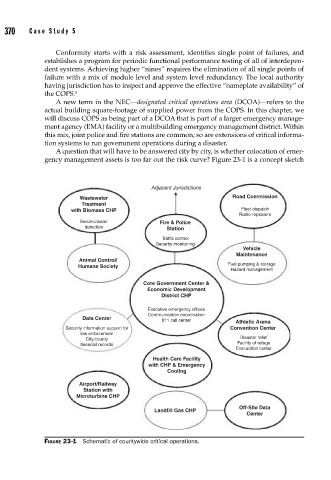
             gency management assets is too far out the risk curve? Figure 23-1 is a concept sketch


                                           Adjacent Jurisdictions
                       Wastewater                                 Road Commission
                        Treatment
                     with Biomass CHP                               Fleet dispatch
                                                                    Radio repeaters
                       Seismic/water         Fire & Police
                         detection
                                               Station
                                              Traffic control
                                            Security monitoring
                                                                     Vehicle
                                                                   Maintenance
                       Animal Control/
                       Humane Society                           Fuel pumping & storage
                                                                 Hazard management
                                         Core Government Center &
                                          Economic Development
                                              District CHP

                                          Executive emergency offices
                                          Communication coordination
                        Data Center           911 call center      Athletic Arena
                   Security information support for              Convention Center
                       law enforcement
                         City/county                                Disaster relief
                       financial records                           Facility of refuge
                                                                   Evacuation center
                                            Health Care Facility
                                          with CHP & Emergency
                                                Cooling
                       Airport/Railway
                        Station with
                      Microturbine CHP
                                                                    Off-Site Data
                                            Landfill Gas CHP
                                                                      Center


             FIGURE 23-1  Schematic of countywide critical operations.

