


Page 392 - Sustainable On-Site CHP Systems Design, Construction, and Operations
P. 392
University Campus CHP Analysis      365


             how the break-even point will shift as electricity and gas rates change. Generally, the
             break-even point will rise with rising gas prices and fall with rising electricity prices.
             The graph also shows that the break-even point will remain constant if the ratio of gas-
             to-electric prices remains constant.


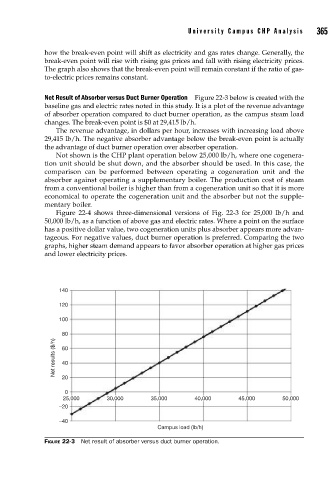
             Net Result of Absorber versus Duct Burner Operation  Figure 22-3 below is created with the
             baseline gas and electric rates noted in this study. It is a plot of the revenue advantage
             of absorber operation compared to duct burner operation, as the campus steam load
             changes. The break-even point is $0 at 29,415 lb/h.
                The revenue advantage, in dollars per hour, increases with increasing load above
             29,415 lb/h. The negative absorber advantage below the break-even point is actually
             the advantage of duct burner operation over absorber operation.
                Not shown is the CHP plant operation below 25,000 lb/h, where one cogenera-
             tion unit should be shut down, and the absorber should be used. In this case, the
             comparison can be performed between operating a cogeneration unit and the
             absorber against operating a supplementary boiler. The production cost of steam
             from a conventional boiler is higher than from a cogeneration unit so that it is more
             economical to operate the cogeneration unit and the absorber but not the supple-
             mentary boiler.
                Figure 22-4 shows three-dimensional versions of Fig. 22-3 for 25,000 lb/h and
             50,000 lb/h, as a function of above gas and electric rates. Where a point on the surface
             has a positive dollar value, two cogeneration units plus absorber appears more advan-
             tageous. For negative values, duct burner operation is preferred. Comparing the two
             graphs, higher steam demand appears to favor absorber operation at higher gas prices
             and lower electricity prices.


                 140
                 120

                 100
                  80
                Net results ($/h)  60


                  40

                  20
                   0
                  25,000       30,000      35,000      40,000      45,000       50,000
                 –20
                 –40
                                             Campus load (lb/h)

             FIGURE 22-3  Net result of absorber versus duct burner operation.

