


Page 389 - Sustainable On-Site CHP Systems Design, Construction, and Operations
P. 389
362    Ca s e  S t u d y 4


                In the break-even analysis, the expense per ton-hour is 0.70 kWh/ton-h × $0.10/kWh
             = $0.07/ton-h and the revenue is valued at $0.11/ton-h.
             Break-Even Analysis
             The object of this case study analysis is to compare the economic advantage of the fol-
             lowing two scenarios:
                  1.  Operating both cogeneration units and the single-effect absorption chiller
                  2.  Operating only one cogeneration unit and firing its turbine exhaust duct burner
                    to meet campus steam demand


             Economic Model
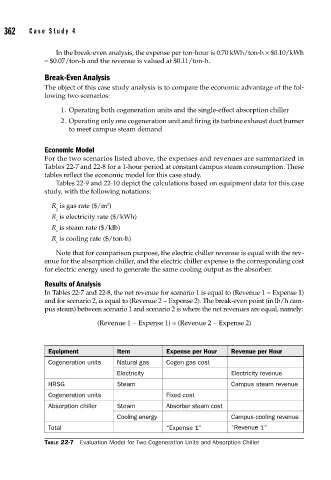
             For the two scenarios listed above, the expenses and revenues are summarized in
             Tables 22-7 and 22-8 for a 1-hour period at constant campus steam consumption. These
             tables reflect the economic model for this case study.
                Tables 22-9 and 22-10 depict the calculations based on equipment data for this case
             study, with the following notations:

                               3
               R  is gas rate ($/m )
                 g
               R  is electricity rate ($/kWh)
                 e
               R  is steam rate ($/klb)
                 s
               R  is cooling rate ($/ton-h)
                 c
                Note that for comparison purpose, the electric chiller revenue is equal with the rev-
             enue for the absorption chiller, and the electric chiller expense is the corresponding cost
             for electric energy used to generate the same cooling output as the absorber.
             Results of Analysis
             In Tables 22-7 and 22-8, the net revenue for scenario 1 is equal to (Revenue 1 − Expense 1)
             and for scenario 2, is equal to (Revenue 2 − Expense 2). The break-even point (in lb/h cam-
             pus steam) between scenario 1 and scenario 2 is where the net revenues are equal, namely:
                            (Revenue 1 − Expense 1) = (Revenue 2 − Expense 2)


              Equipment           Item         Expense per Hour  Revenue per Hour
              Cogeneration units  Natural gas  Cogen gas cost
                                  Electricity                    Electricity revenue
              HRSG                Steam                          Campus steam revenue
              Cogeneration units               Fixed cost
              Absorption chiller  Steam        Absorber steam cost
                                  Cooling energy                 Campus cooling revenue
              Total                            “Expense 1”       “Revenue 1”
             TABLE 22-7  Evaluation Model for Two Cogeneration Units and Absorption Chiller

