


Page 384 - Sustainable On-Site CHP Systems Design, Construction, and Operations
P. 384
University Campus CHP Analysis      357


             Cogeneration Equipment
             The cogeneration plant consists of
                 •  Two combustion turbine generator sets
                 •  Two heat recovery steam generators (HRSGs), with integrated natural gas–fired
                    duct burners
                Each of the turbine generators has a capacity of approximately 5 MW of electricity
             at 13.8 kV and can produce 25,000 lb/h of steam at 275 psig in the unfired HRSG. When
             the duct burners within the HRSG operate, the total steam production of each HRSG
             increases from 25,000 lb/h to 65,000 lb/h of saturated 275-psig steam, for a combined
             output of 130,000 lb/h. Firing the duct burners to increase the steam generation capacity
             is possible with the combustion turbine exhaust gases that are rich in oxygen and at
             high temperature. The additional 40,000 lb/h of steam are produced at 94.5 percent
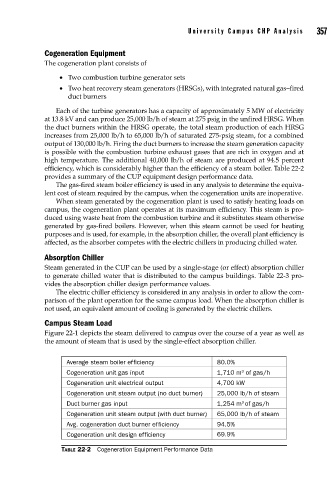
             efficiency, which is considerably higher than the efficiency of a steam boiler. Table 22-2
             provides a summary of the CUP equipment design performance data.
                The gas-fired steam boiler efficiency is used in any analysis to determine the equiva-
             lent cost of steam required by the campus, when the cogeneration units are inoperative.
                When steam generated by the cogeneration plant is used to satisfy heating loads on
             campus, the cogeneration plant operates at its maximum efficiency. This steam is pro-
             duced using waste heat from the combustion turbine and it substitutes steam otherwise
             generated by gas-fired boilers. However, when this steam cannot be used for heating
             purposes and is used, for example, in the absorption chiller, the overall plant efficiency is
             affected, as the absorber competes with the electric chillers in producing chilled water.

             Absorption Chiller
             Steam generated in the CUP can be used by a single-stage (or effect) absorption chiller
             to generate chilled water that is distributed to the campus buildings. Table 22-3 pro-
             vides the absorption chiller design performance values.
                The electric chiller efficiency is considered in any analysis in order to allow the com-
             parison of the plant operation for the same campus load. When the absorption chiller is
             not used, an equivalent amount of cooling is generated by the electric chillers.
             Campus Steam Load
             Figure 22-1 depicts the steam delivered to campus over the course of a year as well as
             the amount of steam that is used by the single-effect absorption chiller.


                   Average steam boiler efficiency           80.0%
                                                                    3
                   Cogeneration unit gas input               1,710 m  of gas/h
                   Cogeneration unit electrical output       4,700 kW
                   Cogeneration unit steam output (no duct burner)  25,000 lb/h of steam
                                                                    3
                   Duct burner gas input                     1,254 m of gas/h
                   Cogeneration unit steam output (with duct burner)  65,000 lb/h of steam
                   Avg. cogeneration duct burner efficiency  94.5%
                   Cogeneration unit design efficiency       69.9%
                  TABLE 22-2  Cogeneration Equipment Performance Data

