


Page 383 - Sustainable On-Site CHP Systems Design, Construction, and Operations
P. 383
356    Ca s e  S t u d y 4


                 •  Domestic cold water
                 •  Domestic hot water
                 •  Compressed air
                Over time, typical university campuses expand and many facilities are in need of reno-
             vation and/or retrofit. In addition, many institutions have embraced sustainability as the
             foundation of their facility operations, and adopted sustainable development policies.
                Given the mix of required utilities, which almost always includes electricity, heat-
             ing, and cooling energy, the combined generation of heat and power becomes a very
             attractive option for universities that are faced with requirements to meet increased
             campus loads or retrofit/replace older equipment.
                This case study analyzed the operation of a diversified central utilities plant and
             offers a methodology to help facilitate the decision-making process for the plant opera-
             tors faced with open energy market conditions.


        Central Utilities Plant Description
             The university campus considered for this analysis includes buildings with a total area
             of approximately 7.5 million square feet. These facilities are served by a central utilities
             plant (CUP) and a distribution system with

                 •  Steam—generated by
                    •  Two cogeneration units
                    •  Four steam boilers
                 •  Chilled water—produced by
                    •  Six electric chillers
                    •  One absorption chiller
                 •  Electricity—generated by
                    •  Two cogeneration units
                 •  Compressed air—generated by
                    •  Three air compressors
                 •  Domestic water supplied by the municipality
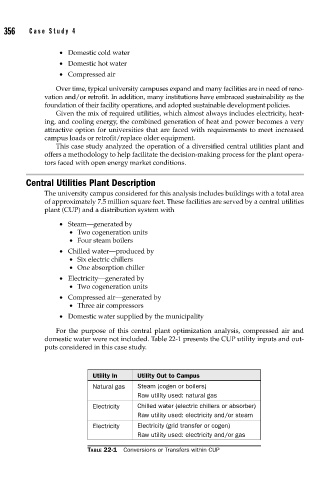
                For the purpose of this central plant optimization analysis, compressed air and
             domestic water were not included. Table 22-1 presents the CUP utility inputs and out-
             puts considered in this case study.


                           Utility In  Utility Out to Campus
                           Natural gas  Steam (cogen or boilers)
                                       Raw utility used: natural gas
                           Electricity  Chilled water (electric chillers or absorber)
                                       Raw utility used: electricity and/or steam
                           Electricity  Electricity (grid transfer or cogen)
                                       Raw utility used: electricity and/or gas
                         TABLE 22-1  Conversions or Transfers within CUP

